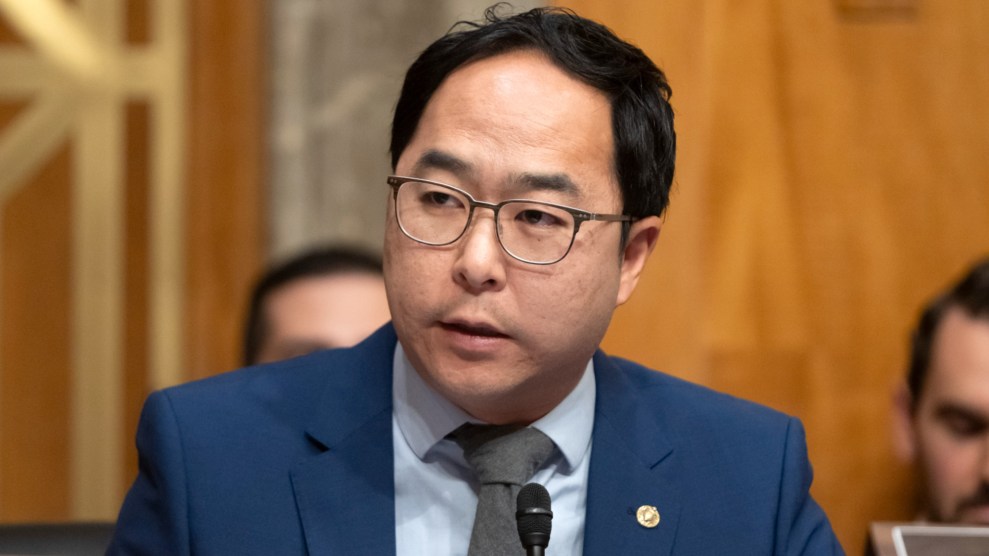
Rep. Lateefah Simon speaking at a rally.Gent Shkullaku/Zuma
On November 29, 1975, Republican President Gerald Ford signed the Education for All Handicapped Children Act into law, which later became the Individuals with Disabilities Education Act (IDEA). IDEA requires that disabled students have access to public education, discourages segregating disabled kids from their peers, and that qualifying students have access to individualized education plans, more commonly known as IEPs. IDEA does not apply to education in private schools.
“Before our disabled elders secured our rights under the law, disabled kids were locked out of systems and out of their potential,” Rep. Lateefah Simon (D-Ca.), who is blind, told me in a statement.
Many disability advocates are concerned about the state of education for disabled kids. Continued attempts to dismantle the Department of Education by President Donald Trump and Education Secretary Linda McMahon, as well as attempts to fire their staff, put the oversight that disabled kids’ needs are met at risk. Such oversight includes putting districts on notice for funding if they overpenalize Black disabled students, for instance. Then, there is the longstanding issue that IDEA has never been fully funded, meaning that the federal government is not funding IEPs to 40 percent.
“Congress must protect and fully fund the IDEA to ensure future generations of disabled children have the supports and services they need to thrive in school,” Simon continued. “Our civil rights are not up for negotiations.”
This is not to say that all students’ needs are adequately met under the IDEA. Jordyn Zimmerman, a nonspeaking autistic person, told me that she did not have access to effective communication via iPad until she was 18.
“When I finally gained access to effective communication, required under IDEA and also the ADA, there was a realization that I could learn, and I was slowly included in the school community, until I graduated at the age of 21,” Zimmerman said, who is the board chair of CommunicationFIRST. “So that really highlights, both the flaws, but also the power in when the spirit is fulfilled with intentionality.”
Zimmerman is also very concerned about attacks on the Department of Education. “Without a strong Department of Education, states can redirect money away from students with disabilities, so that high-quality education will only exist for some,” Zimmerman said. “Students also won’t get the funding for the therapies, assistive technology, and specially-designed instruction that students need, and families depend on.”
“I will fight that with everything that I have, because IEPs are protection for these kids.”
Samantha Phillis, an advocate with Little Lobbyists, told me that her two daughters, who are in public school, are on IEPs, one of whom is autistic and one has spinal muscular atrophy. Phillis is currently experiencing her school trying to walk back her autistic kid’s IEP, which she suspects is common for kids with disabilities who appear to have lower support needs.
“I will fight that with everything that I have, because IEPs are protection for these kids,” Phillis said.
Phillis’ daughter with spinal muscular atrophy also has a nurse with her at all times in school due to her complex health needs. The nurse receives some funding through Medicaid, so Phillis is also terrified about how Medicaid cuts will impact her daughter’s ability to attend school. “It’s one of the biggest heartbreaks I think I’ve ever experienced in my entire life is seeing how people like my daughters are affected by this administration,” Phillis told me.
There have not been recent attempts to repeal IDEA yet, though Project 2025 encourages funding to be given directly to states, but this is a concern for Nadia Hasan, a woman with cerebral palsy who credits IDEA with helping her succeed in school. “There’s just a lot more like isolation and lack of opportunity,” Hasan told me.
Marleen Salazar, a Texan with learning disabilities who is now an undergraduate student at the University of Texas Rio Grande Valley, credits her special education teachers for helping her learn to advocate for herself.
“They were very much a very key part of building me that confidence and advocacy to make sure that I expressed what I needed and what I didn’t need,” Salazar told me. This advocacy included being able to take standardized tests in a room by herself, as well as getting extended time.
Salazar’s younger sister, who is dyslexic, now has accommodations as well. Salazar has concerns about what will happen if funding is rolled back. “The fear is if funding is cut, or the state doesn’t want to provide these resources anymore, what does that mean for her in the future?”