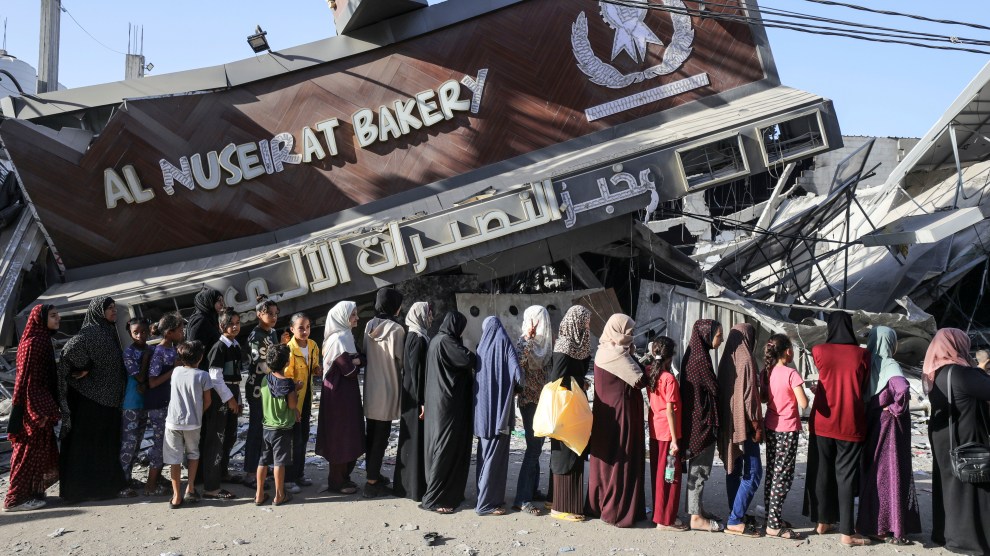
People queue for bread in front of a bakery that was partially destroyed by an Israeli strike in the Nuseirat refugee camp in Gaza.Majdi Fathi/AP
The average Palestinian in Gaza is currently living on two pieces of bread a day, a United Nations official said on Friday.
Thomas White, the Gaza director for the UN agency for Palestinian refugees, noted in a briefing with other UN members that in addition to food being extremely scarce in Gaza, water is in short supply as well, and Gazans are pleading for more.
The United Nations Relief and Works Agency for Palestine Refugees in the Near East is helping support 89 bakeries across Gaza that are trying to get bread to the area’s 1.7 million people, according to the AP, which reported on White’s remarks.
UN Deputy Mideast coordinator Lynn Hastings, who is also the humanitarian coordinator for Palestine, said during the briefing that just one of three waterlines from Israel is working. “Many people are relying on brackish or saline groundwater, if at all,” she said.
UN humanitarian chief Martin Griffiths noted that the situation in Gaza could become even more dire as fuel, which helps run healthcare facilities, water distribution, and desalinization plants, runs out.
Griffiths explained that sewage isn’t being treated and instead is being pumped into the sea. “But when you speak to municipal workers, the reality is once their fuel runs out, that sewage will flow in the streets,” he said.
Israel has sought to limit aid to Gaza, arguing that resources meant for Gazans could be usurped by Hamas. US special envoy David Satterfield said on Saturday, though, that there is no evidence that Hamas has blocked or seized any aid yet.
Griffiths said that Egypt, Israel, and the United States are negotiating to let fuel into Gaza. He also called for humanitarian pauses to get aid to millions of people between Israeli bombing and military ground operations. But Riyad Mansour, the Palestinian UN ambassador criticized this idea saying that a humanitarian pause amounts to a situation where “Israel continues killing the Palestinians, but gives us few hours every now and then, in order to get food and other stuff.” Mansour called for an indefinite ceasefire instead to give severely ravaged Gaza a reprieve.
So far, more than 9,000 Palestinians have been killed by Israeli military action, including more than 3,600 children. An additional 140 Palestinians have also been killed in the occupied West Bank.