<a href="http://www.flickr.com/photos/gageskidmore/6183942539/sizes/l/in/photostream/">Gage Skidmore</a>/Flickr
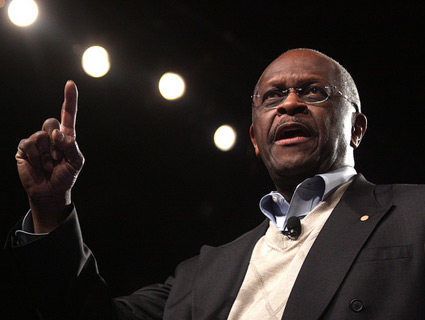
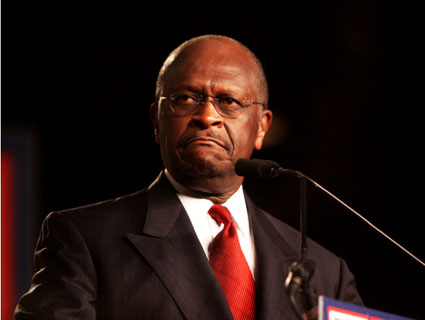
ABC News has crunched the numbers and reported what independent analysts had basically been saying for a while now: Herman Cain’s 9-9-9 plan, despite his promises to the contrary, would almost double the amount middle-class Americans pay in taxes (low-income earners would see their tax burden increase nine-fold.)
There are a number of different components to this, but one of the most glaring elements of 9-9-9 is that it puts a 9 percent federal sales tax on food. That’s on top of whatever other sales tax exists (Alabama and Mississippi, for instance, already apply a full sales tax to groceries). Cain says that this is only fair, because everyone buys groceries. But that ignores the fact that taxing groceries is incredibly regressive. As you can see in this handy chart, poor people have to spend a much higher percentage of their income on food than rich people. Obviously, with more disposable income you can buy fancier varieties of food and do all your shopping at Whole Foods, but there’s a limit even then; it’s not as if Warren Buffett subsists entirely on $1,600 muffins:
 Self-explanatory: The less money you have, the more of it you have to spend on food.: Courtesy of the USDAPoor Americans spend a lower percentage of their income on food than the rest of the world because poor Americans are pretty well-off, relative to the rest of the world, but the overall trend is pretty obvious. Cain has attempted to argue away the point that 9-9-9 is regressive by noting that under 9-9-9, there would be no tax on used goods. Food isn’t much good once it’s already been used once, though.