A Flood of Unusual Accuracy

Get your news from a source that’s not owned and controlled by oligarchs. Sign up for the free Mother Jones Daily.


Credit: Malene Thyssen, courtesy Wikimedia Commons.Credit: Malene Thyssen, courtesy Wikimedia Commons.

An interesting analysis in Environmental Research Letters of the accuracy of media reporting of climate-related sea level rise. The premise: That the mass media associates sea level rise with climate change and reports on it frequently, yet the scientific community remains dubious of the media’s accuracy.

So how good or bad is the situation really? The authors examined the accuracy of reporting between 1989 and 2009 by seven prominent US and UK newspapers:

  • New York Times
  • Washington Post
  • Los Angeles Times
  • Financial Times
  • The Times (London)
  • The Guardian
  • The Telegraph
 Credit: NASA.Credit: NASA.
 
Their findings—a surprise to me and I suspect to the authors too—that journalists have done an excellent job portraying scientific research on sea level rise projections to 2100.
 
So why the unease? 
 
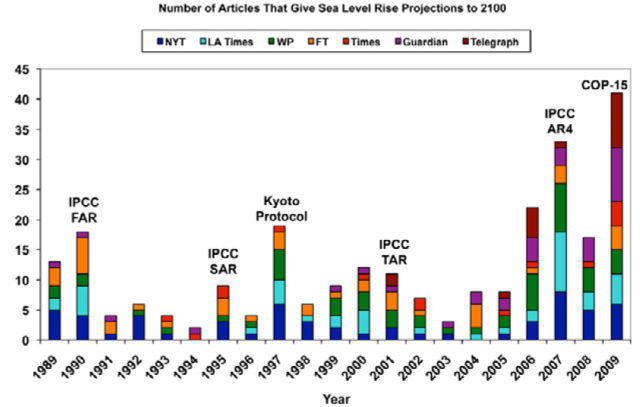
Well it turns out that while coverage of the issue of sea level rise has risen in the past 20 years, it’s done so in fits and starts pegged to major news cycles—the release of an IPCC report, the 1997 Kyoto Protocol, the 2009 COP-15.


Credit: Environmental Research Letters DOI:10.1088/1748-9326/6/1/014004)Credit: Environmental Research Letters DOI:10.1088/1748-9326/6/1/014004

There’s been little to no coverage of direct research, the completion of specific projections, or the publication of incremental but important papers. For those milestones, the mass media is largely silent. Obviously this speaks to the different tool sets of media and science—media being the microphone, science the microscope. If we can ever get them working together, we’ll get real traction against the flood.


Credit: Wikinedia Commons.Credit: Wikimedia Commons.

The authors conclude:

Mass media presentations of climate change remain key influences that bound discourses and shape the spectrum of possibility for climate mitigation and adaptation actions. Amid much recent criticism of climate science and the media on the high-stakes, high pro?le and highly politicized issue, accurate reporting on projections for sea level rise by 2100 demonstrates a bright spot at the interface of climate science and mass media. These ?ndings can contribute to more measured considerations of climate impacts and policy action in the public sphere.
  
The paper:

 Crossposted from Deep Blue Home.

BEFORE YOU CLICK AWAY!

December is make or break for us. A full one-third of our annual fundraising comes in this month alone. A strong December means our newsroom is on the beat and reporting at full strength. A weak one means budget cuts and hard choices ahead.

The December 31 deadline is closing in fast. To reach our $400,000 goal, we need readers who’ve never given before to join the ranks of MoJo donors. And we need our steadfast supporters to give again today—any amount.

Managing an independent, nonprofit newsroom is staggeringly hard. There’s no cushion in our budget—no backup revenue, no corporate safety net. We can’t afford to fall short, and we can’t rely on corporations or deep-pocketed interests to fund the fierce, investigative journalism Mother Jones exists to do.

That’s why we need you right now. Please chip in to help close the gap.

BEFORE YOU CLICK AWAY!

December is make or break for us. A full one-third of our annual fundraising comes in this month alone. A strong December means our newsroom is on the beat and reporting at full strength. A weak one means budget cuts and hard choices ahead.

The December 31 deadline is closing in fast. To reach our $400,000 goal, we need readers who’ve never given before to join the ranks of MoJo donors. And we need our steadfast supporters to give again today—any amount.

Managing an independent, nonprofit newsroom is staggeringly hard. There’s no cushion in our budget—no backup revenue, no corporate safety net. We can’t afford to fall short, and we can’t rely on corporations or deep-pocketed interests to fund the fierce, investigative journalism Mother Jones exists to do.

That’s why we need you right now. Please chip in to help close the gap.

We Recommend

Latest

Sign up for our free newsletter

Subscribe to the Mother Jones Daily to have our top stories delivered directly to your inbox.

Get our award-winning magazine

Save big on a full year of investigations, ideas, and insights.

Subscribe

Support our journalism

Help Mother Jones' reporters dig deep with a tax-deductible donation.

Donate