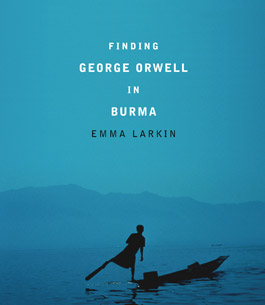
Finding George Orwell in Burma

By Emma Larkin. <i>The Penguin Press</i>.

Get your news from a source that’s not owned and controlled by oligarchs. Sign up for the free Mother Jones Daily.


In 1950, George Orwell started work on a sequel to his novel Burmese Days, based on his stint as an imperial administrator in Mandalay. He got only three pages into the new story before he died of tuberculosis. In Finding George Orwell in Burma, journalist Emma Larkin takes up this unfinished task, trying to decode the country with the help of the author who is known by some Burmese simply as “the prophet.”

In the pseudonymous Larkin, the secretive Burmese dictatorship has found its perfect foreign narrator. All we know for sure about her is that she is an American who was born and raised in Asia, is based in Bangkok, and speaks fluent Burmese. She heads to Burma in the mid-1990s, as it endures a severe crackdown on its pro-democracy movement. With intelligence men close behind, she travels from Rangoon to Orwell’s old up-country post and points beyond, meeting with intellectuals, shopkeepers, and hoteliers, who also must take assumed names for their own protection.

What Larkin discovers is, well, Orwellian. Describing the junta, she writes, “The grand plan, if there is a plan at all, is to abolish the power of thinking.” In Mandalay she finds a George Orwell book club debating the author’s legacy. Not surprisingly, 1984 is banned there, but a book collector digs up an old copy of Animal Farm, calling it “a very Burmese book…. Because it is about pigs and dogs ruling the country!”

Though she faces greater constraints than Orwell, and could have easily fictionalized her experience, as he did, Larkin sticks to the facts. The result is one of the most unusual travelogues to come out of Southeast Asia in some time, and a truer picture of authoritarianism than anyone has written since, perhaps, Orwell himself.

BEFORE YOU CLICK AWAY!

December is make or break for us. A full one-third of our annual fundraising comes in this month alone. A strong December means our newsroom is on the beat and reporting at full strength. A weak one means budget cuts and hard choices ahead.

The December 31 deadline is closing in fast. To reach our $400,000 goal, we need readers who’ve never given before to join the ranks of MoJo donors. And we need our steadfast supporters to give again today—any amount.

Managing an independent, nonprofit newsroom is staggeringly hard. There’s no cushion in our budget—no backup revenue, no corporate safety net. We can’t afford to fall short, and we can’t rely on corporations or deep-pocketed interests to fund the fierce, investigative journalism Mother Jones exists to do.

That’s why we need you right now. Please chip in to help close the gap.

BEFORE YOU CLICK AWAY!

December is make or break for us. A full one-third of our annual fundraising comes in this month alone. A strong December means our newsroom is on the beat and reporting at full strength. A weak one means budget cuts and hard choices ahead.

The December 31 deadline is closing in fast. To reach our $400,000 goal, we need readers who’ve never given before to join the ranks of MoJo donors. And we need our steadfast supporters to give again today—any amount.

Managing an independent, nonprofit newsroom is staggeringly hard. There’s no cushion in our budget—no backup revenue, no corporate safety net. We can’t afford to fall short, and we can’t rely on corporations or deep-pocketed interests to fund the fierce, investigative journalism Mother Jones exists to do.

That’s why we need you right now. Please chip in to help close the gap.

We Recommend

Latest

Sign up for our free newsletter

Subscribe to the Mother Jones Daily to have our top stories delivered directly to your inbox.

Get our award-winning magazine

Save big on a full year of investigations, ideas, and insights.

Subscribe

Support our journalism

Help Mother Jones' reporters dig deep with a tax-deductible donation.

Donate