Stripping the Seas

How humans have ‘harvested’ the oceans to emptiness.

Get your news from a source that’s not owned and controlled by oligarchs. Sign up for the free Mother Jones Daily.


One thing that humans are very proficient at is killing. Since man started hunting in boats, we have been killing everything we could catch from the world’s oceans. We’ve killed for food, ornament, fertilizer, and fuel. We kill by accident (the term commercial fisheries use is “bycatch”), out of carelessness, and frequently for the sheer hell of it.

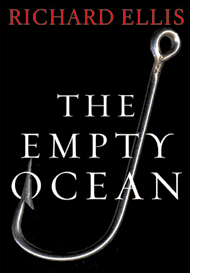
For most of our history, given the vastness of the oceans and the seemingly unlimited life therein, we couldn’t impact most species of fish, whales, turtles, seals, and seabirds. Now, though, as Richard Ellis bluntly argues in this important and aptly named book, we have the resources and the technological wherewithal to so reduce so many species of ocean life that the ecological consequences are incalculable.

By continuing to “harvest” sea life as if it were boundless, we have nearly finished off the fisheries of cod, sardines, and anchovies, and are fast working our way through the remaining tuna, swordfish, large sharks, Chilean sea bass, and Atlantic salmon. How is this possible? It’s as simple as demand outpacing supply. “A million vessels now fish the world’s oceans,” Ellis writes, “twice as many as there were 25 years ago.”

This is not an easy book. Ellis is fond of facts and numbers, and with them he’s fashioned a nigh-overwhelming elegy for the victims of our gill nets and drift nets, factory fishing ships, explosive harpoons, longlines, trawlers, and fish-spotting aircraft — not to mention our collective shortsightedness.

Among the obstacles to halting this enormous, long-running tragedy: Powerful economic interests skew the policies of such regulatory bodies as the U.S. National Marine Fisheries Service, while much of the overfishing takes place in international waters where no one country or organization can manage what’s left of the “resources.”

Is there any hope? Maybe not much, but consider that the depleted species themselves are resilient and, given half a chance, can and do rebound, albeit slowly. Ellis notes that marine reserves — “no-fish” zones — have proved effective and should be established on a larger scale. Still, time is short, and the oceans’ precious biodiversity is already damaged. As Pogo put it and Ellis would agree, the enemy is us.

BEFORE YOU CLICK AWAY!

December is make or break for us. A full one-third of our annual fundraising comes in this month alone. A strong December means our newsroom is on the beat and reporting at full strength. A weak one means budget cuts and hard choices ahead.

The December 31 deadline is closing in fast. To reach our $400,000 goal, we need readers who’ve never given before to join the ranks of MoJo donors. And we need our steadfast supporters to give again today—any amount.

Managing an independent, nonprofit newsroom is staggeringly hard. There’s no cushion in our budget—no backup revenue, no corporate safety net. We can’t afford to fall short, and we can’t rely on corporations or deep-pocketed interests to fund the fierce, investigative journalism Mother Jones exists to do.

That’s why we need you right now. Please chip in to help close the gap.

BEFORE YOU CLICK AWAY!

December is make or break for us. A full one-third of our annual fundraising comes in this month alone. A strong December means our newsroom is on the beat and reporting at full strength. A weak one means budget cuts and hard choices ahead.

The December 31 deadline is closing in fast. To reach our $400,000 goal, we need readers who’ve never given before to join the ranks of MoJo donors. And we need our steadfast supporters to give again today—any amount.

Managing an independent, nonprofit newsroom is staggeringly hard. There’s no cushion in our budget—no backup revenue, no corporate safety net. We can’t afford to fall short, and we can’t rely on corporations or deep-pocketed interests to fund the fierce, investigative journalism Mother Jones exists to do.

That’s why we need you right now. Please chip in to help close the gap.

We Recommend

Latest

Sign up for our free newsletter

Subscribe to the Mother Jones Daily to have our top stories delivered directly to your inbox.

Get our award-winning magazine

Save big on a full year of investigations, ideas, and insights.

Subscribe

Support our journalism

Help Mother Jones' reporters dig deep with a tax-deductible donation.

Donate