A BCG Chart Can Tell You What’s Safe and What’s Not

What’s dangerous and what isn’t? Erin Bromage, a professor of biology at the University of Massachusetts Dartmouth, has a pretty useful roundup here. The main lesson is: it’s all about Volume x Time. That is, it’s dangerous to be in places with a large volume of viral particles and it’s also dangerous to be in places that might have low volumes but require you to stay a long time. As a former management dweeb, I immediately had to put this into BCG chart form:
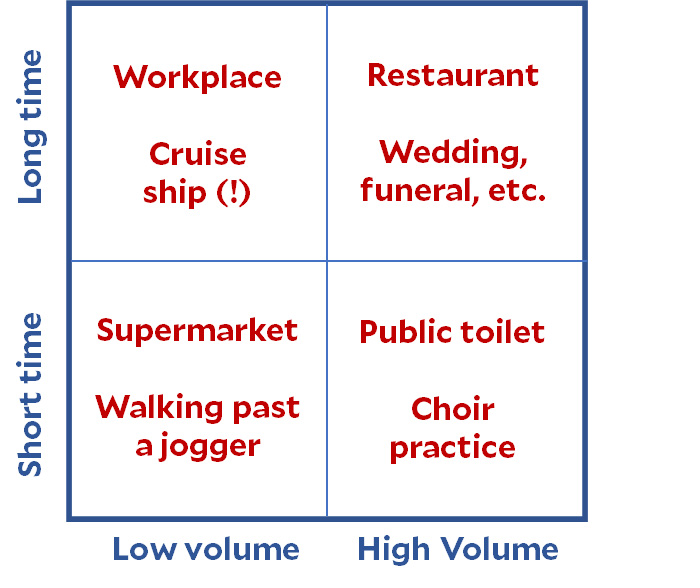
Supermarkets, Bromage says, are generally fairly low in viral particles; aren’t very crowded; and usually require only 30-60 minutes of your time. They’re pretty safe. Conversely, a public toilet requires only a few minutes of your time but is shockingly high in viral particles if an infected person has been in it recently.

Indoor workplaces mostly have fairly modest volumes of viral particles, with obvious exceptions like meatpacking plants. However, you’re there eight hours a day. If anyone is infected, there’s a decent chance you will be too. And then there are restaurants, which can have quite high viral loads and often take 2-3 hours of your time.

Anyway, read the whole thing. “The main sources for infection,” Bromage says, “are home, workplace, public transport, social gatherings, and restaurants. This accounts for 90% of all transmission events.” The rest of the piece is pretty helpful too.
BEFORE YOU CLICK AWAY!

December is make or break for us. A full one-third of our annual fundraising comes in this month alone. A strong December means our newsroom is on the beat and reporting at full strength. A weak one means budget cuts and hard choices ahead.

The December 31 deadline is closing in fast. To reach our $400,000 goal, we need readers who’ve never given before to join the ranks of MoJo donors. And we need our steadfast supporters to give again today—any amount.

Managing an independent, nonprofit newsroom is staggeringly hard. There’s no cushion in our budget—no backup revenue, no corporate safety net. We can’t afford to fall short, and we can’t rely on corporations or deep-pocketed interests to fund the fierce, investigative journalism Mother Jones exists to do.

That’s why we need you right now. Please chip in to help close the gap.

BEFORE YOU CLICK AWAY!

December is make or break for us. A full one-third of our annual fundraising comes in this month alone. A strong December means our newsroom is on the beat and reporting at full strength. A weak one means budget cuts and hard choices ahead.

The December 31 deadline is closing in fast. To reach our $400,000 goal, we need readers who’ve never given before to join the ranks of MoJo donors. And we need our steadfast supporters to give again today—any amount.

Managing an independent, nonprofit newsroom is staggeringly hard. There’s no cushion in our budget—no backup revenue, no corporate safety net. We can’t afford to fall short, and we can’t rely on corporations or deep-pocketed interests to fund the fierce, investigative journalism Mother Jones exists to do.

That’s why we need you right now. Please chip in to help close the gap.

We Recommend

Latest

Sign up for our free newsletter

Subscribe to the Mother Jones Daily to have our top stories delivered directly to your inbox.

Get our award-winning magazine

Save big on a full year of investigations, ideas, and insights.

Subscribe

Support our journalism

Help Mother Jones' reporters dig deep with a tax-deductible donation.

Donate