Chart of the Day: The Housing Bubble Increased Racial Segregation

Get your news from a source that’s not owned and controlled by oligarchs. Sign up for the free Mother Jones Daily.

Via Suzy Khimm, here’s an interesting bit of research from Amine Ouazad and Romain Rancière. During the housing boom of the aughts, it became easier for low-income families to buy more expensive homes. Since African-American families have lower incomes than average, this suggests that the housing boom, on average, should have allowed them to move into less segregated neighborhoods.

And it did. But it also allowed white and Hispanic families to move, and it turns out that Hispanic families mostly moved into Hispanic neighborhoods:

Hispanic families have used the easier access to credit to buy houses in predominantly Hispanic neighbourhoods with the consequence of enrolling their children in schools with fewer black peers, and more Hispanic and white peers. We estimate that, because of the credit boom, black students in 2006 had 2% fewer Hispanic peers….Credit markets enabled a substantial fraction of Hispanic families to live in neighbourhoods with fewer black families, even though a substantial fraction of black families were moving to more racially integrated areas.

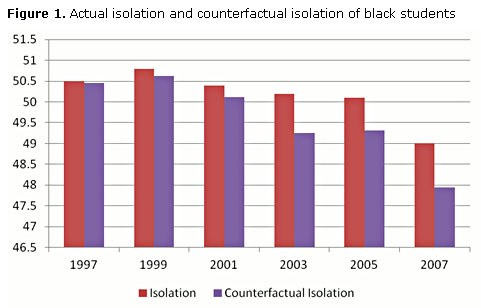
The chart below shows the impact of the housing boom on black household segregation. In 1997, black students in public schools had an “isolation” of 50.5%. That is, 50.5% of their peers were black. By 2007, that had dropped to 49%. But the housing boom actually slowed the rate of decline. The authors conclude that if the housing boom had never happened, black isolation would have dropped to 48%. Their conclusion: “The net effect is that credit markets increased racial segregation.” 
BEFORE YOU CLICK AWAY!

December is make or break for us. A full one-third of our annual fundraising comes in this month alone. A strong December means our newsroom is on the beat and reporting at full strength. A weak one means budget cuts and hard choices ahead.

The December 31 deadline is closing in fast. To reach our $400,000 goal, we need readers who’ve never given before to join the ranks of MoJo donors. And we need our steadfast supporters to give again today—any amount.

Managing an independent, nonprofit newsroom is staggeringly hard. There’s no cushion in our budget—no backup revenue, no corporate safety net. We can’t afford to fall short, and we can’t rely on corporations or deep-pocketed interests to fund the fierce, investigative journalism Mother Jones exists to do.

That’s why we need you right now. Please chip in to help close the gap.

BEFORE YOU CLICK AWAY!

December is make or break for us. A full one-third of our annual fundraising comes in this month alone. A strong December means our newsroom is on the beat and reporting at full strength. A weak one means budget cuts and hard choices ahead.

The December 31 deadline is closing in fast. To reach our $400,000 goal, we need readers who’ve never given before to join the ranks of MoJo donors. And we need our steadfast supporters to give again today—any amount.

Managing an independent, nonprofit newsroom is staggeringly hard. There’s no cushion in our budget—no backup revenue, no corporate safety net. We can’t afford to fall short, and we can’t rely on corporations or deep-pocketed interests to fund the fierce, investigative journalism Mother Jones exists to do.

That’s why we need you right now. Please chip in to help close the gap.

We Recommend

Latest

Sign up for our free newsletter

Subscribe to the Mother Jones Daily to have our top stories delivered directly to your inbox.

Get our award-winning magazine

Save big on a full year of investigations, ideas, and insights.

Subscribe

Support our journalism

Help Mother Jones' reporters dig deep with a tax-deductible donation.

Donate