It Looks Like the Stimulus Worked After All

Get your news from a source that’s not owned and controlled by oligarchs. Sign up for the free Mother Jones Daily.

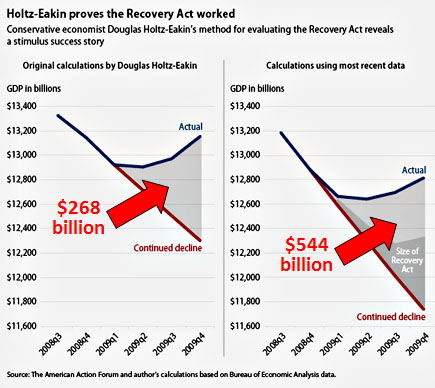
Conservative economist Douglas Holtz-Eakin has a chart he’s fond of that demonstrates just how ineffective the 2009 stimulus was. Basically, it shows that the stimulus cost $260 billion and produced only an extra $268 billion in GDP. Personally, I’d take even that, but his point is that the stimulus produced no Keynesian multiplier effect at all. It was just a 1:1 replacement of revenue from one source to another.

But as you may recall, the US Bureau of Economic Analysis recently revised its GDP estimates from late 2008 and 2009, and it turns out the economy was doing much worse than we thought. And if you don’t recall this, Michael Linden wants to remind you about it today. He also wants to remind Douglas Holtz-Eakin about it. Because it turns out that when you redo Holtz-Eakin’s favorite chart using the corrected data, it suggests that the stimulus bill produced about $544 billion in extra GDP. In other words, a multiplier effect of about 2x.
I suppose there are two ways to respond to this. Holtz-Eakin could admit that he was wrong. Or he could invent a reason that his old chart is no good and then scurry back to his computer to produce a brand new chart using a different methodology that, once again, shows that the stimulus didn’t work. We’ll see which way he chooses.

BEFORE YOU CLICK AWAY!

December is make or break for us. A full one-third of our annual fundraising comes in this month alone. A strong December means our newsroom is on the beat and reporting at full strength. A weak one means budget cuts and hard choices ahead.

The December 31 deadline is closing in fast. To reach our $400,000 goal, we need readers who’ve never given before to join the ranks of MoJo donors. And we need our steadfast supporters to give again today—any amount.

Managing an independent, nonprofit newsroom is staggeringly hard. There’s no cushion in our budget—no backup revenue, no corporate safety net. We can’t afford to fall short, and we can’t rely on corporations or deep-pocketed interests to fund the fierce, investigative journalism Mother Jones exists to do.

That’s why we need you right now. Please chip in to help close the gap.

BEFORE YOU CLICK AWAY!

December is make or break for us. A full one-third of our annual fundraising comes in this month alone. A strong December means our newsroom is on the beat and reporting at full strength. A weak one means budget cuts and hard choices ahead.

The December 31 deadline is closing in fast. To reach our $400,000 goal, we need readers who’ve never given before to join the ranks of MoJo donors. And we need our steadfast supporters to give again today—any amount.

Managing an independent, nonprofit newsroom is staggeringly hard. There’s no cushion in our budget—no backup revenue, no corporate safety net. We can’t afford to fall short, and we can’t rely on corporations or deep-pocketed interests to fund the fierce, investigative journalism Mother Jones exists to do.

That’s why we need you right now. Please chip in to help close the gap.

We Recommend

Latest

Sign up for our free newsletter

Subscribe to the Mother Jones Daily to have our top stories delivered directly to your inbox.

Get our award-winning magazine

Save big on a full year of investigations, ideas, and insights.

Subscribe

Support our journalism

Help Mother Jones' reporters dig deep with a tax-deductible donation.

Donate