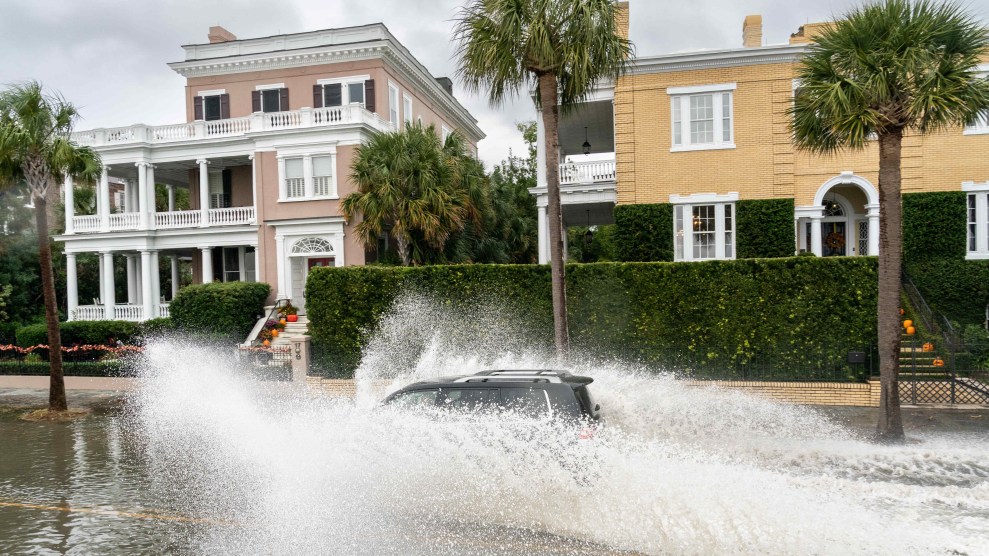
Historic flooding in Charleston, South Carolina in November 2021Richard Ellis/Zuma
Sea levels along the US coasts are expected to rise 10 to 12 inches by 2050, according to a new report by the National Oceanic and Atmospheric Administration. That’s as much as they’ve risen over the past 100 years, and the greatest acceleration in sea level rise in the last 3,000 years, according to NOAA.
Scientists have long understood the mechanisms behind sea level rise: Human-caused carbon emissions are warming the planet, which is both melting land-based ice and causing thermal expansion of ocean water, elevating sea levels around the world. But while the next foot of sea level rise is likely locked in, we can avoid further catastrophic flooding by curbing emissions immediately.
The report, released this week, has estimates with greater confidence than those in a similar report from 2017. The new report predicts that moderate flooding will occur 10 times as often in 2050 as it does today.
For years, we have known the solution. One of NOAA’s three main takeaways is just “Emissions Matter.” If we curb our penchant for collectively belching carbon in the name of “normalcy,” we can keep the sea level rise along the US coast to 2 feet by 2100; if we don’t, sea levels could rise by up to 7 feet—enough to send swaths of lower Manhattan underwater.
In short, rising tides will inundate our coastlines in many of our lifetimes. Reide Corbett, executive director of the Coastal Studies Institute, told the Washington Post, “If we’re talking about 2050—for someone buying a house today, that’s within the range of their mortgage.” Even if we stave off runaway global heating and keep sea level rise to a nice, 10- to 12-inch minimum, 140,000 homes along US coasts will be at risk of flooding every other week, Kristina Dahl, a climate scientist with the Union of Concerned Scientists, told the Post.
It’s telling that one of the main ways we can think to make people care about massive destruction to our coasts is to make it about the American dream of homeownership. Many of the people likely to live through the era of rising sea levels will not be able to afford to buy a house. Now is the time to invest in coastal resiliency projects, not only to safeguard your own property value, but to ensure that those who can’t afford to relocate won’t have to.