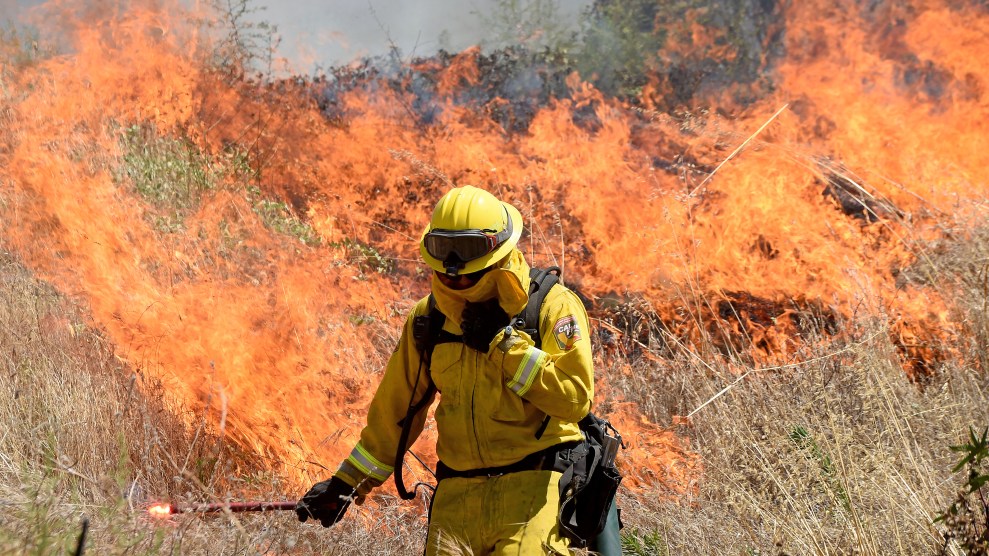
Rising temperatures mean more wildfires, like this one in Riverside, California in 2019.Will Lester/SCNG/Zuma
In case you needed further proof that the world is heating up, the National Oceanic and Atmospheric Administration just released its updated climate averages from the past 30 years, showing a 1 degree Celsius rise in average temperatures since the beginning of the 20th century.
The NOAA applies complex statistical methods to readings from thousands of reporting stations to determine “climate normals.” The new data from the 30-year span from 1991 to 2020 shows an average temperature for the contiguous United States of 53.3 degrees Fahrenheit—the highest ever recorded, the Washington Post reports. That represents a 1.7 degree Fahrenheit (1 degree Celsius) increase since 1901–1930, the first period for which NOAA has calculated normals. That number may not seem like a lot, but it has huge implications for everything from farming to utility regulation.
Precipitation, while not as simple to parse as rising temperatures, is trending higher as well. Rainfall and snowfall are increasingly characterized by intense bursts separated by long dry periods. This reminds me of the pattern laid out by Al Gore 15 years ago in An Inconvenient Truth: “Warmer water increases the moisture content of storms, and warmer air holds more moisture. When storm conditions trigger a downpour, more of it falls in the form of big, one-time rainfalls and snowfalls. Partly as a result, the number of large flood events has increased decade by decade, on every continent.”
If you want to see what a short and particularly intense cloudburst looks like, check out this recent footage from Austria.
Dear friends watch this surprising video Photographer Peter Maier captured this Cloudburst over Lake Millstatt in Carinthia, Austria.
A cloudburst is a sudden and violent rainstorm capable of producing an extreme amount of precipitation in a short period of time @honeyviscous pic.twitter.com/IOom4fCEgv— चन्द्र भान सिंह कौरव 🇮🇳 (@singhcbk) October 5, 2020
And here’s some video from Pattrn, one of our Climate Desk partners.
.@NOAA revealed their new climate normals today.
See why one major Alaskan city can no longer be classified as “subarctic.” pic.twitter.com/OCXlB8RaFD
— Pattrn (@pattrn) May 4, 2021