How Big Is the Underground Cost of Health Care?

I should preface this post by saying that it’s serious. This is not just a rant of some kind.

For some time I’ve been wondering about the cost of health care in the US vs. other similar countries. As we all know, the US has by far the highest cost among rich countries:
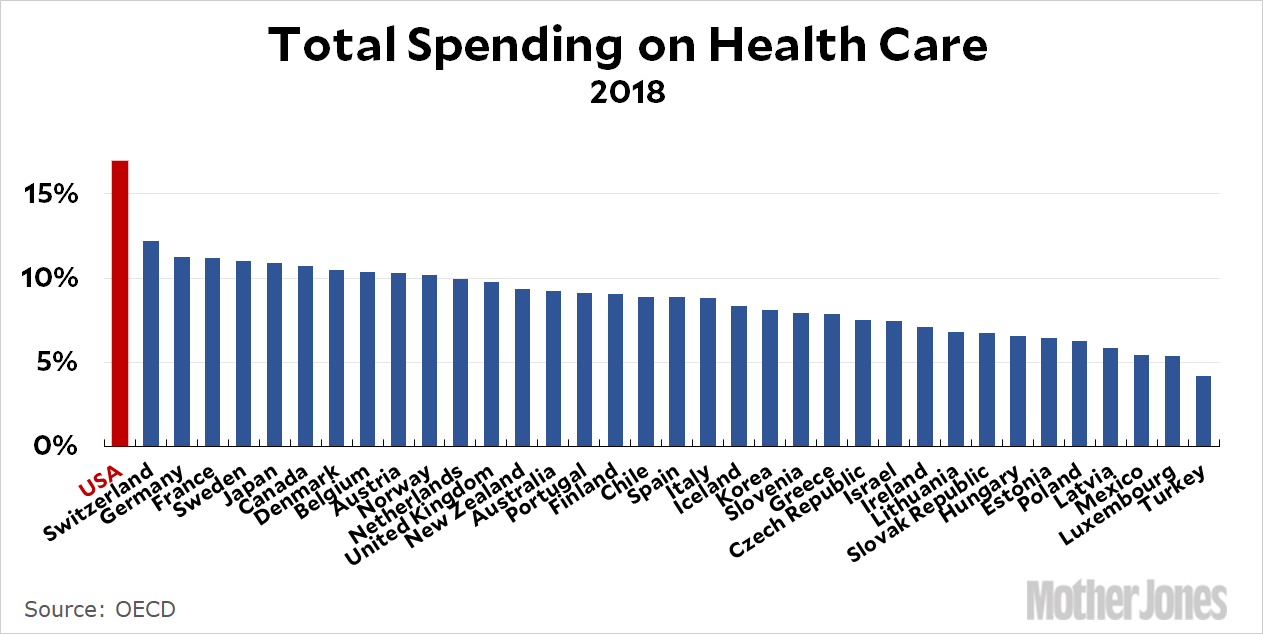
This is bad enough. But it includes only the money cost of professional health care provision. As such, it misses a big part of the picture.

I was finally prompted to write about this because I’ve had a higher than usual engagement with the health care system over the past few weeeks. It’s gone the way it always goes: it’s massively inefficient and prone to errors, most of which end up falling on patients to fix. There’s the hours spent on hold making appointments. There’s the constant checking for medication errors. There’s the endless arguing with insurance companies. There’s the back-and-forth process of telling doctors what some other doctor said because they never talk to each other. There’s the miscommunications caused by the fact that doctors typically know nothing about the actual operation of their own industry. Etc.

These are all things we’re familiar with, and they’re basically elements of the health care system that are outsourced to patients themselves. It never gets accounted for, but for all practical purposes the health care system relies on the unpaid labor of patients to keep itself in operation. It’s a real cost, but it’s hard to measure.

I have never seen a study that tries to compare this underground cost among countries. This makes me curious: Is the US system unusually inefficient? Does it produce more work for patients compared to other countries? Or is this just the nature of dealing with a big and highly complex industry?

It would be difficult to study, but probably worth it. Who would be a good candidate?
BEFORE YOU CLICK AWAY!

December is make or break for us. A full one-third of our annual fundraising comes in this month alone. A strong December means our newsroom is on the beat and reporting at full strength. A weak one means budget cuts and hard choices ahead.

The December 31 deadline is closing in fast. To reach our $400,000 goal, we need readers who’ve never given before to join the ranks of MoJo donors. And we need our steadfast supporters to give again today—any amount.

Managing an independent, nonprofit newsroom is staggeringly hard. There’s no cushion in our budget—no backup revenue, no corporate safety net. We can’t afford to fall short, and we can’t rely on corporations or deep-pocketed interests to fund the fierce, investigative journalism Mother Jones exists to do.

That’s why we need you right now. Please chip in to help close the gap.

BEFORE YOU CLICK AWAY!

December is make or break for us. A full one-third of our annual fundraising comes in this month alone. A strong December means our newsroom is on the beat and reporting at full strength. A weak one means budget cuts and hard choices ahead.

The December 31 deadline is closing in fast. To reach our $400,000 goal, we need readers who’ve never given before to join the ranks of MoJo donors. And we need our steadfast supporters to give again today—any amount.

Managing an independent, nonprofit newsroom is staggeringly hard. There’s no cushion in our budget—no backup revenue, no corporate safety net. We can’t afford to fall short, and we can’t rely on corporations or deep-pocketed interests to fund the fierce, investigative journalism Mother Jones exists to do.

That’s why we need you right now. Please chip in to help close the gap.

We Recommend

Latest

Sign up for our free newsletter

Subscribe to the Mother Jones Daily to have our top stories delivered directly to your inbox.

Get our award-winning magazine

Save big on a full year of investigations, ideas, and insights.

Subscribe

Support our journalism

Help Mother Jones' reporters dig deep with a tax-deductible donation.

Donate