Get your news from a source that’s not owned and controlled by oligarchs. Sign up for the free Mother Jones Daily.

This is arcane, but I guess I need to follow up on my post last night about the CBO’s report on extending tax cuts. I think I’ve figured out what’s going on.

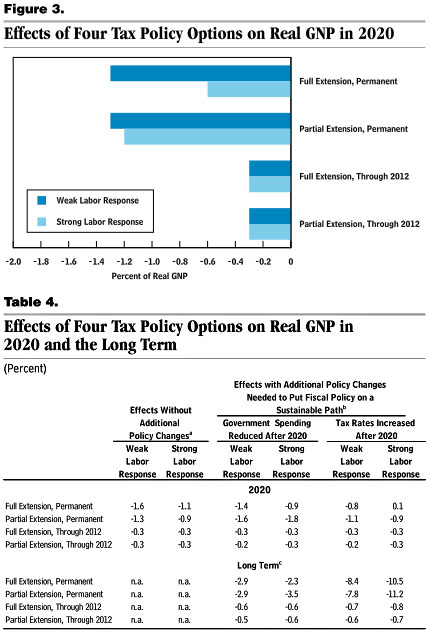
The CBO chart is below, and it doesn’t seem to match the data in Table 4. But it does, sort of. Take the bar for full extension of tax cuts with a weak labor response. According to Table 4, its effect in 2020 is to reduce real GNP by 1.6%. That’s if everyone assumes there’s no response. But if we assume that government spending will be reduced after 2020, a lifecycle model predicts that the net effect of extension is only -1.4%. If we assume a tax increase after 2020, the lifecycle model predicts that the net effect is -0.8%.

Now average all those together and you get -1.26%. That rounds to -1.3%, and that’s what’s shown in the chart. If you average all the other options they also match the chart.

Is this simple arithmetic averaging legit? Beats me. And I’m not even sure who to ask. But apparently that’s what they did.

One more thing, though. The CBO model suggests that in all cases, a policy response to full extension of the tax cuts reduces the long-term damage. However, a policy response to extension of just the middle-class cuts increases the long-term damage or has only a tiny effect. This seems like a very strange result. Why does a policy response (either lower spending or higher taxes) have a strongly positive effect in one case and a bad or negligible effect in the other? Again, I’m not even sure who to ask. But it seems odd even if you’re a supply side die hard.
BEFORE YOU CLICK AWAY!

December is make or break for us. A full one-third of our annual fundraising comes in this month alone. A strong December means our newsroom is on the beat and reporting at full strength. A weak one means budget cuts and hard choices ahead.

The December 31 deadline is closing in fast. To reach our $400,000 goal, we need readers who’ve never given before to join the ranks of MoJo donors. And we need our steadfast supporters to give again today—any amount.

Managing an independent, nonprofit newsroom is staggeringly hard. There’s no cushion in our budget—no backup revenue, no corporate safety net. We can’t afford to fall short, and we can’t rely on corporations or deep-pocketed interests to fund the fierce, investigative journalism Mother Jones exists to do.

That’s why we need you right now. Please chip in to help close the gap.

BEFORE YOU CLICK AWAY!

December is make or break for us. A full one-third of our annual fundraising comes in this month alone. A strong December means our newsroom is on the beat and reporting at full strength. A weak one means budget cuts and hard choices ahead.

The December 31 deadline is closing in fast. To reach our $400,000 goal, we need readers who’ve never given before to join the ranks of MoJo donors. And we need our steadfast supporters to give again today—any amount.

Managing an independent, nonprofit newsroom is staggeringly hard. There’s no cushion in our budget—no backup revenue, no corporate safety net. We can’t afford to fall short, and we can’t rely on corporations or deep-pocketed interests to fund the fierce, investigative journalism Mother Jones exists to do.

That’s why we need you right now. Please chip in to help close the gap.

We Recommend

Latest

Sign up for our free newsletter

Subscribe to the Mother Jones Daily to have our top stories delivered directly to your inbox.

Get our award-winning magazine

Save big on a full year of investigations, ideas, and insights.

Subscribe

Support our journalism

Help Mother Jones' reporters dig deep with a tax-deductible donation.

Donate