Share of People Who Can Cover a $400 Expense Went Up in 2017

Every year we learn that lots of people don’t have enough savings to cover a $400 emergency expense. Here’s the Post yesterday:

Four in 10 adults still say they don’t have enough savings to cover a $400 emergency expense, according to the latest Federal Reserve report on the economic well-being of Americans. While that is an improvement over 2013, when half of Americans said they could not cover a $400 expense, it remains elevated at a time when unemployment is so low and wages are rising.

This is a reminder, says Heather Long, “that the U.S. economy has deep structural problems that are far from being cured.”

I suppose so. But I finally got curious about where this statistic comes from every year like clockwork, and the answer turns out to be the Federal Reserve’s “Report on the Economic Well-Being of U.S. Households.” It’s based on their annual Survey of Household Economics and Decisionmaking (SHED), which they’ve been conducting since 2013. Here are a couple of charts from the 2017 report:
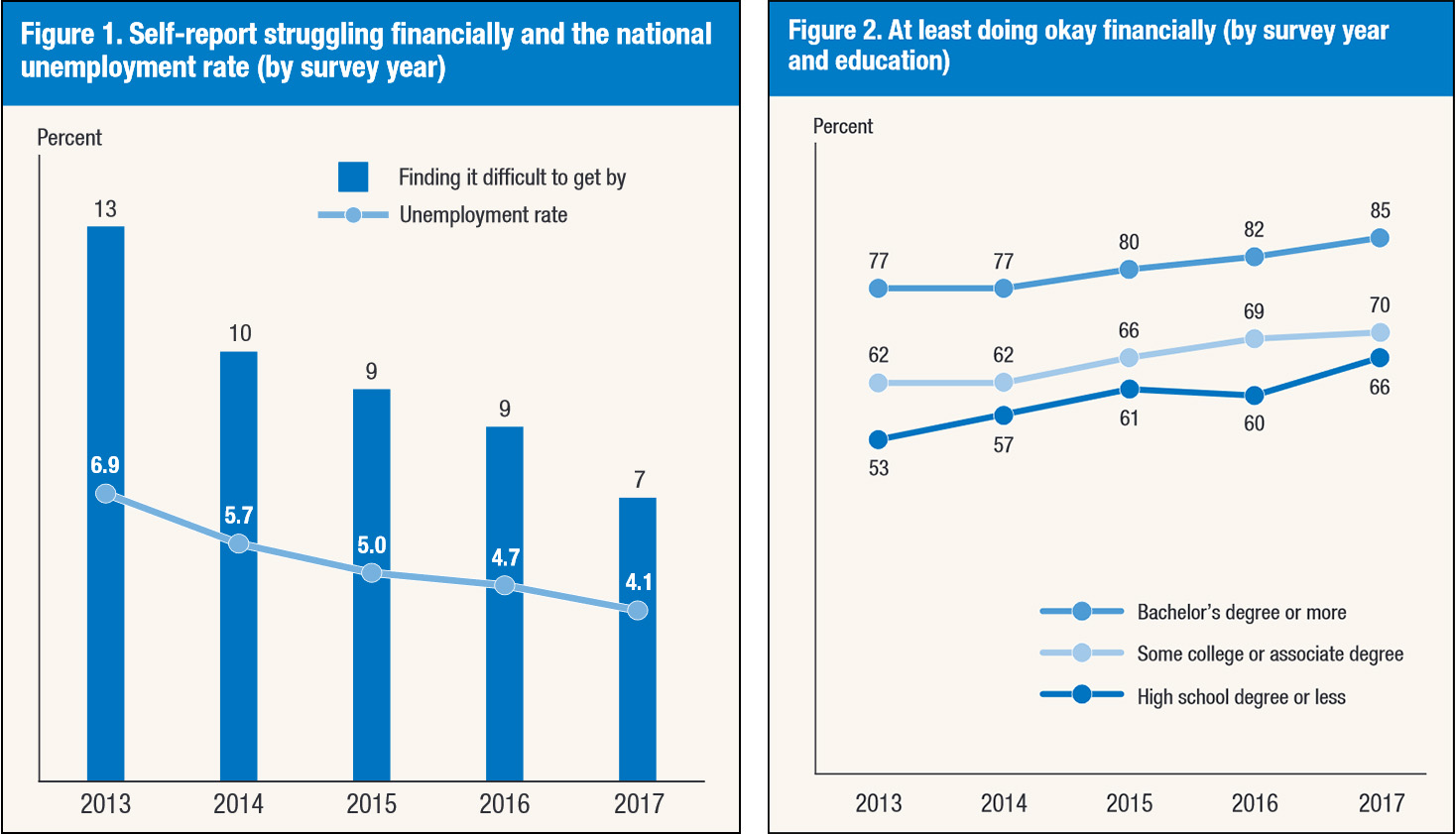
Both of these charts suggest that although we’re not yet in financial nirvana, pretty much everyone has been doing steadily better over the past five years. And only 7 percent of the population reports that they’re finding it “difficult to get by.” Now here’s the $400 emergency expense chart:
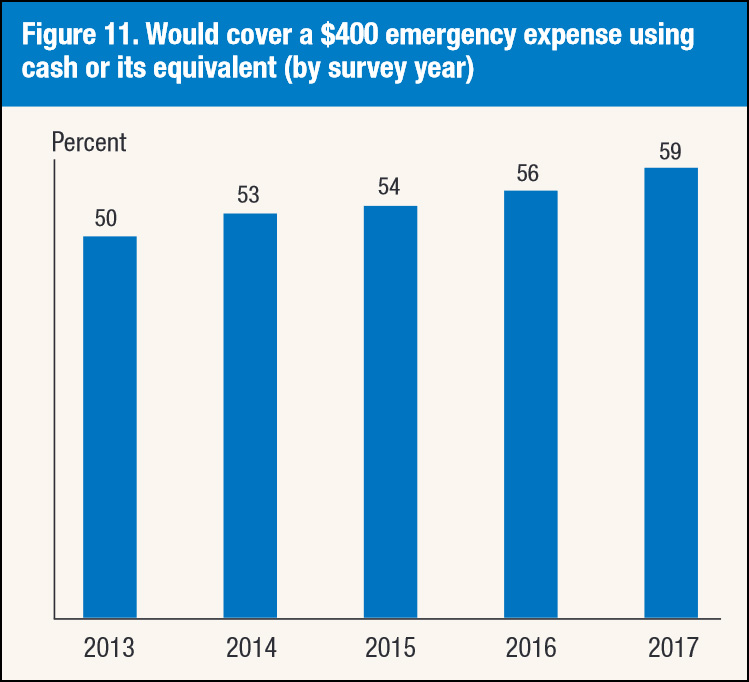
That’s going steadily up too. It’s certainly true, as Fed chair Jerome Powell says, that aggregate statistics “tend to mask important disparities by income, race and geography,” but it’s also true that things are getting better for just about everyone.

They aren’t getting better very fast, though, and there’s probably a recession due in the next year or two. That’s when we’ll find out just how resilient our economy really is and how well our lowest-income workers are doing.
BEFORE YOU CLICK AWAY!

December is make or break for us. A full one-third of our annual fundraising comes in this month alone. A strong December means our newsroom is on the beat and reporting at full strength. A weak one means budget cuts and hard choices ahead.

The December 31 deadline is closing in fast. To reach our $400,000 goal, we need readers who’ve never given before to join the ranks of MoJo donors. And we need our steadfast supporters to give again today—any amount.

Managing an independent, nonprofit newsroom is staggeringly hard. There’s no cushion in our budget—no backup revenue, no corporate safety net. We can’t afford to fall short, and we can’t rely on corporations or deep-pocketed interests to fund the fierce, investigative journalism Mother Jones exists to do.

That’s why we need you right now. Please chip in to help close the gap.

BEFORE YOU CLICK AWAY!

December is make or break for us. A full one-third of our annual fundraising comes in this month alone. A strong December means our newsroom is on the beat and reporting at full strength. A weak one means budget cuts and hard choices ahead.

The December 31 deadline is closing in fast. To reach our $400,000 goal, we need readers who’ve never given before to join the ranks of MoJo donors. And we need our steadfast supporters to give again today—any amount.

Managing an independent, nonprofit newsroom is staggeringly hard. There’s no cushion in our budget—no backup revenue, no corporate safety net. We can’t afford to fall short, and we can’t rely on corporations or deep-pocketed interests to fund the fierce, investigative journalism Mother Jones exists to do.

That’s why we need you right now. Please chip in to help close the gap.

We Recommend

Latest

Sign up for our free newsletter

Subscribe to the Mother Jones Daily to have our top stories delivered directly to your inbox.

Get our award-winning magazine

Save big on a full year of investigations, ideas, and insights.

Subscribe

Support our journalism

Help Mother Jones' reporters dig deep with a tax-deductible donation.

Donate