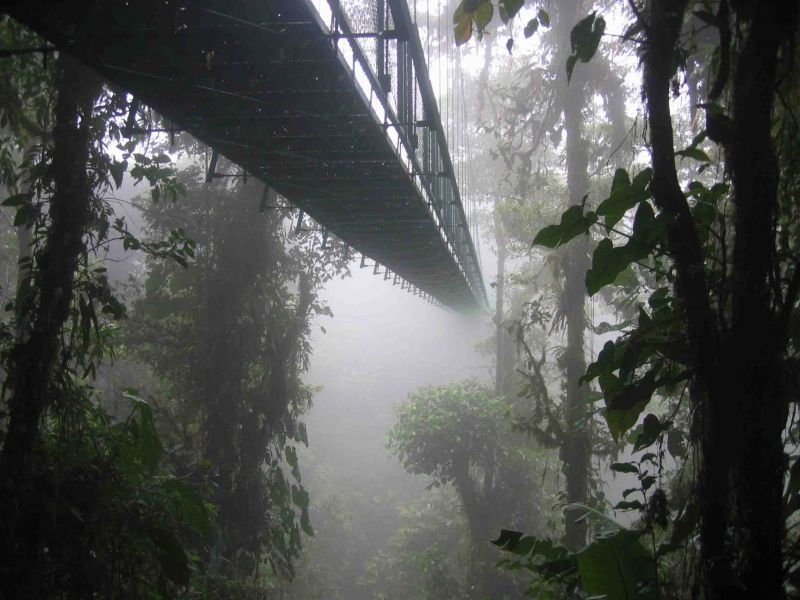
Save a Rainforest, Reduce Poverty

Photo by Dirk van der Made, courtesy Wikimedia Commons

Get your news from a source that’s not owned and controlled by oligarchs. Sign up for the free Mother Jones Daily.


A new study disputes a widely-held assumption that protecting forest resources exacerbates poverty for people living nearby.

Instead, this novel research shows that saving rainforests and protecting land in national parks and reserves reduced poverty in Costa Rica and Thailand. The researchers looked at the long term impacts of poor people living near parks and reserves established in 1985 or earlier. From the abstract:

“As global efforts to protect ecosystems expand, the socioeconomic impact of protected areas on neighboring human communities continues to be a source of intense debate. The debate persists because previous studies do not directly measure socioeconomic outcomes and do not use appropriate comparison groups to account for potential confounders. We illustrate an approach using comprehensive national datasets and quasi-experimental matching methods. We estimate impacts of protected area systems on poverty in Costa Rica and Thailand and find that although communities near protected areas are indeed substantially poorer than national averages, an analysis based on comparison with appropriate controls does not support the hypothesis that these differences can be attributed to protected areas. In contrast, the results indicate that the net impact of ecosystem protection was to alleviate poverty.”

Coauthor and economist Paul J. Ferraro tells Georgia State University the results are counterintuitive:

“Most people might expect that if you restrict resources, people on average will be worse off.”

The authors speculate that conservation of biodiverse areas may help poor people through tourism and infrastructure, notably new roads providing new economic opportunities.

The paper is open access at PNAS;
 

BEFORE YOU CLICK AWAY!

December is make or break for us. A full one-third of our annual fundraising comes in this month alone. A strong December means our newsroom is on the beat and reporting at full strength. A weak one means budget cuts and hard choices ahead.

The December 31 deadline is closing in fast. To reach our $400,000 goal, we need readers who’ve never given before to join the ranks of MoJo donors. And we need our steadfast supporters to give again today—any amount.

Managing an independent, nonprofit newsroom is staggeringly hard. There’s no cushion in our budget—no backup revenue, no corporate safety net. We can’t afford to fall short, and we can’t rely on corporations or deep-pocketed interests to fund the fierce, investigative journalism Mother Jones exists to do.

That’s why we need you right now. Please chip in to help close the gap.

BEFORE YOU CLICK AWAY!

December is make or break for us. A full one-third of our annual fundraising comes in this month alone. A strong December means our newsroom is on the beat and reporting at full strength. A weak one means budget cuts and hard choices ahead.

The December 31 deadline is closing in fast. To reach our $400,000 goal, we need readers who’ve never given before to join the ranks of MoJo donors. And we need our steadfast supporters to give again today—any amount.

Managing an independent, nonprofit newsroom is staggeringly hard. There’s no cushion in our budget—no backup revenue, no corporate safety net. We can’t afford to fall short, and we can’t rely on corporations or deep-pocketed interests to fund the fierce, investigative journalism Mother Jones exists to do.

That’s why we need you right now. Please chip in to help close the gap.

We Recommend

Latest

Sign up for our free newsletter

Subscribe to the Mother Jones Daily to have our top stories delivered directly to your inbox.

Get our award-winning magazine

Save big on a full year of investigations, ideas, and insights.

Subscribe

Support our journalism

Help Mother Jones' reporters dig deep with a tax-deductible donation.

Donate