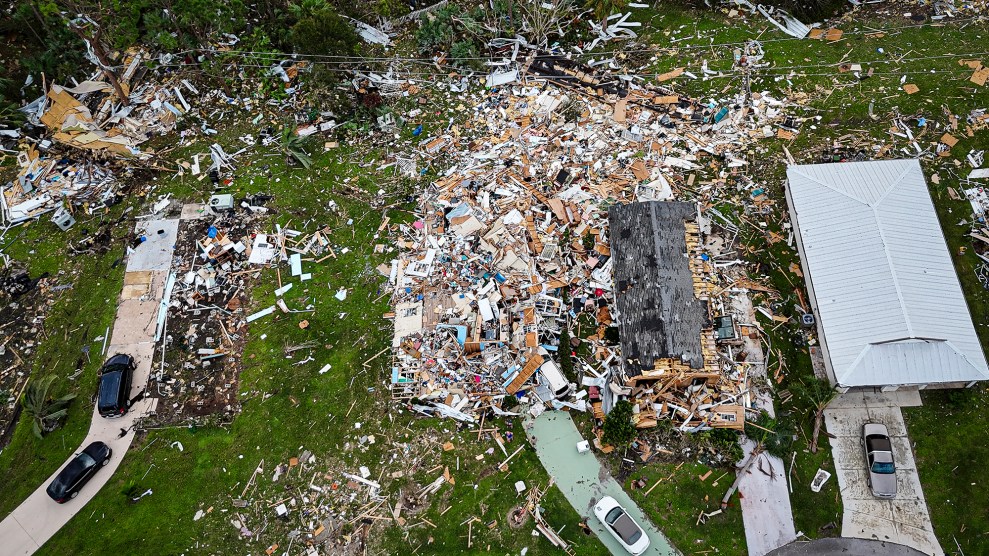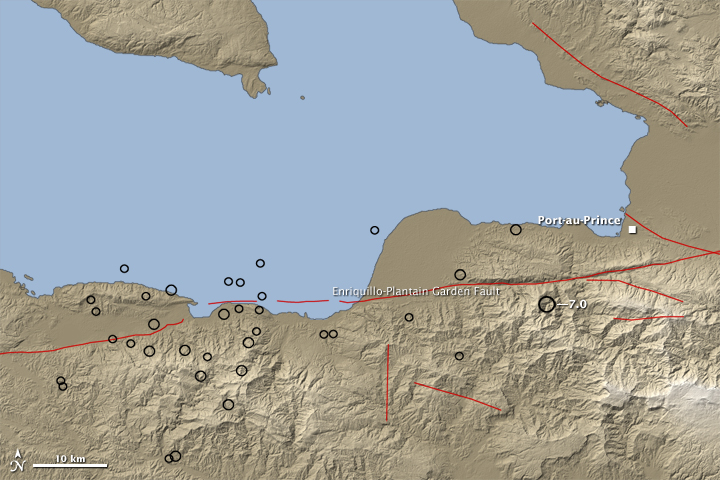
Topography of Haiti’s Scary Faultline

NASA Earth Observatory image by Jesse Allen

Get your news from a source that’s not owned and controlled by oligarchs. Sign up for the free Mother Jones Daily.


Thanks to NASA’s Earth Observatory for this informative graphic and text on the Haiti quake:

“At 4:53 p.m. local time on January 12, 2010, a 7.0-magnitude earthquake struck Hispaniola Island, just 10 miles southwest of the Haitian capital of Port-au-Prince. Besides its strong magnitude, the earthquake’s shallow depth of roughly 5.2 miles ensured that the densely populated capital suffered violent shaking.

“This map shows the topography and tectonic influences in the region of the earthquake. Lighter colors indicate higher elevation. Black circles mark earthquake locations determined by the U.S. Geological Survey, and circle sizes correspond with quake magnitudes. Dozens of aftershocks followed the main quake. Red lines indicate fault lines.

“The epicenter of the quake appears just south of the Enriquillo-Plaintain Garden Fault, the southernmost of two major east-west-trending faults that bear the stress of the convergence of the Caribbean and North America tectonic plates in this location. Though faults are weak spots or fractures in the Earth’s crust below the surface, very often there are topographical clues to their presence. In this case, the presence of the fault is indicated by long, straight valley cutting through southern Haiti, just south of Port-Au-Prince. The Enriquillo-Plaintain Garden Fault is a strike-slip type fault, with the Caribbean plate moving eastward with respect to the North America plate.”


BEFORE YOU CLICK AWAY!

December is make or break for us. A full one-third of our annual fundraising comes in this month alone. A strong December means our newsroom is on the beat and reporting at full strength. A weak one means budget cuts and hard choices ahead.

The December 31 deadline is closing in fast. To reach our $400,000 goal, we need readers who’ve never given before to join the ranks of MoJo donors. And we need our steadfast supporters to give again today—any amount.

Managing an independent, nonprofit newsroom is staggeringly hard. There’s no cushion in our budget—no backup revenue, no corporate safety net. We can’t afford to fall short, and we can’t rely on corporations or deep-pocketed interests to fund the fierce, investigative journalism Mother Jones exists to do.

That’s why we need you right now. Please chip in to help close the gap.

BEFORE YOU CLICK AWAY!

December is make or break for us. A full one-third of our annual fundraising comes in this month alone. A strong December means our newsroom is on the beat and reporting at full strength. A weak one means budget cuts and hard choices ahead.

The December 31 deadline is closing in fast. To reach our $400,000 goal, we need readers who’ve never given before to join the ranks of MoJo donors. And we need our steadfast supporters to give again today—any amount.

Managing an independent, nonprofit newsroom is staggeringly hard. There’s no cushion in our budget—no backup revenue, no corporate safety net. We can’t afford to fall short, and we can’t rely on corporations or deep-pocketed interests to fund the fierce, investigative journalism Mother Jones exists to do.

That’s why we need you right now. Please chip in to help close the gap.

We Recommend

Latest

Sign up for our free newsletter

Subscribe to the Mother Jones Daily to have our top stories delivered directly to your inbox.

Get our award-winning magazine

Save big on a full year of investigations, ideas, and insights.

Subscribe

Support our journalism

Help Mother Jones' reporters dig deep with a tax-deductible donation.

Donate