Economic Dishonesty

Get your news from a source that’s not owned and controlled by oligarchs. Sign up for the free Mother Jones Daily.

This John Schmitt takedown of economist/New York Times blogger Casey Mulligan seems pretty damning. Mulligan made the argument that requiring paid sick days is counterproductive because it causes people to stay home when they are not sick. Schmitt explains why this could be wrong:

The current system—which does not require employers to provide paid sick days and leaves upwards of 50 million workers without paid sick days—gives strong incentives to workers to go to work sick, lowering productivity and potentially spreading illness.

Of course, offering paid sick days also gives workers incentives to take time off when they are not sick. There is nothing in Mulligan’s post that says where we should set the optimal level. He doesn’t even make a case that the most generous systems in Europe are too generous, just that they lead to more sickness absences in some cases. For all we know, after we factor in the cost of contagious diseases, the most generous European systems might still be too stingy.

Here’s where it gets embarassing for Mulligan and the Times. To support his point, Mulligan published a graph showing how the Netherlands, Sweden, and Norway, which have statutory sick leave laws, all have higher absenteeism than the United States.
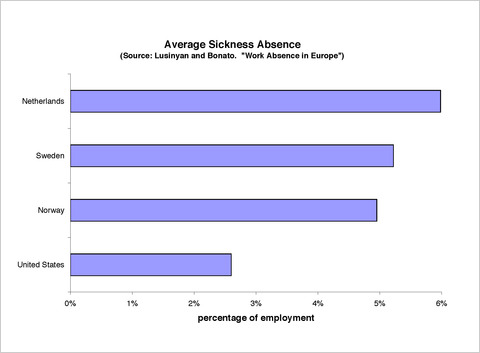
But Mulligan pulled very selectively from his source material, a chart by the International Monetary Fund. Here’s the real chart:

Over to you, John:

In the original, Denmark, Germany, and seven other countries with more generous statutory paid sick days policies all have lower sickness absence rates than the United States. A really interesting question is: how is it that these countries are able to provide both guaranteed paid sick days and lower sickness absence rates? (And why didn’t Mulligan include these countries in his graph?)

Um, because he was being dishonest?
 

BEFORE YOU CLICK AWAY!

December is make or break for us. A full one-third of our annual fundraising comes in this month alone. A strong December means our newsroom is on the beat and reporting at full strength. A weak one means budget cuts and hard choices ahead.

The December 31 deadline is closing in fast. To reach our $400,000 goal, we need readers who’ve never given before to join the ranks of MoJo donors. And we need our steadfast supporters to give again today—any amount.

Managing an independent, nonprofit newsroom is staggeringly hard. There’s no cushion in our budget—no backup revenue, no corporate safety net. We can’t afford to fall short, and we can’t rely on corporations or deep-pocketed interests to fund the fierce, investigative journalism Mother Jones exists to do.

That’s why we need you right now. Please chip in to help close the gap.

BEFORE YOU CLICK AWAY!

December is make or break for us. A full one-third of our annual fundraising comes in this month alone. A strong December means our newsroom is on the beat and reporting at full strength. A weak one means budget cuts and hard choices ahead.

The December 31 deadline is closing in fast. To reach our $400,000 goal, we need readers who’ve never given before to join the ranks of MoJo donors. And we need our steadfast supporters to give again today—any amount.

Managing an independent, nonprofit newsroom is staggeringly hard. There’s no cushion in our budget—no backup revenue, no corporate safety net. We can’t afford to fall short, and we can’t rely on corporations or deep-pocketed interests to fund the fierce, investigative journalism Mother Jones exists to do.

That’s why we need you right now. Please chip in to help close the gap.

We Recommend

Latest

Sign up for our free newsletter

Subscribe to the Mother Jones Daily to have our top stories delivered directly to your inbox.

Get our award-winning magazine

Save big on a full year of investigations, ideas, and insights.

Subscribe

Support our journalism

Help Mother Jones' reporters dig deep with a tax-deductible donation.

Donate