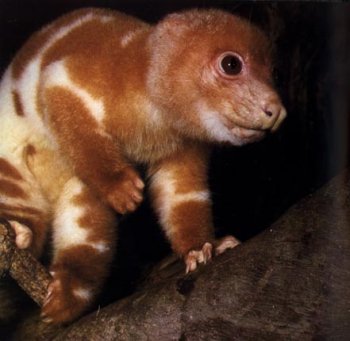
Cute Animal in Danger: Cuscus

Wikimedia commons

Get your news from a source that’s not owned and controlled by oligarchs. Sign up for the free Mother Jones Daily.


The cuscus is a marsupial native to Australia and New Guinea. This nocturnal tree-dweller has opposable toes and fingers like a monkey which help it keep hold of slippery branches. It can also use its long, prehensile tail to keep its balance. The cuscus is actually a member of the opossum family and ranges in length from about one to two feet (with the tail an additional two feet long) and weighing in around 10 lbs. The bottom of their tales are furless, rough and scaly so as to have a better grip. Cuscuses generally eat fruits and leaves, but will snack on eggs and small mammals if it can get them. Though, since the cuscus’s low metabolism and body temperature, they’re slow like a sloth and rarely catch other animals. The cuscus’s main predators are pythons and birds of prey; because cuscuses are largely arboreal, ground-dwelling predators are generally not a problem. Other than man, of course, which sometimes hunts and eats them.

There are a few different kinds of cuscuses. The spotted (pictured above) and gray varieties are not endangered, but the large, splashy-coated black-spotted cuscus is battling poachers for survival. It lives mostly in New Guinean rainforests and is suffering devastating habitat loss from logging and agriculture; it’s also been hunted extensively both for its meat and distinctive, woolly coat. It’s now considered “critically endangered” and due to its remote habitat, it’s not even certain how many of the animals still exist today. Only 18 specimens have ever been collected. As one book said, its “outlook” seems increasingly “bleak.”


BEFORE YOU CLICK AWAY!

December is make or break for us. A full one-third of our annual fundraising comes in this month alone. A strong December means our newsroom is on the beat and reporting at full strength. A weak one means budget cuts and hard choices ahead.

The December 31 deadline is closing in fast. To reach our $400,000 goal, we need readers who’ve never given before to join the ranks of MoJo donors. And we need our steadfast supporters to give again today—any amount.

Managing an independent, nonprofit newsroom is staggeringly hard. There’s no cushion in our budget—no backup revenue, no corporate safety net. We can’t afford to fall short, and we can’t rely on corporations or deep-pocketed interests to fund the fierce, investigative journalism Mother Jones exists to do.

That’s why we need you right now. Please chip in to help close the gap.

BEFORE YOU CLICK AWAY!

December is make or break for us. A full one-third of our annual fundraising comes in this month alone. A strong December means our newsroom is on the beat and reporting at full strength. A weak one means budget cuts and hard choices ahead.

The December 31 deadline is closing in fast. To reach our $400,000 goal, we need readers who’ve never given before to join the ranks of MoJo donors. And we need our steadfast supporters to give again today—any amount.

Managing an independent, nonprofit newsroom is staggeringly hard. There’s no cushion in our budget—no backup revenue, no corporate safety net. We can’t afford to fall short, and we can’t rely on corporations or deep-pocketed interests to fund the fierce, investigative journalism Mother Jones exists to do.

That’s why we need you right now. Please chip in to help close the gap.

We Recommend

Latest

Sign up for our free newsletter

Subscribe to the Mother Jones Daily to have our top stories delivered directly to your inbox.

Get our award-winning magazine

Save big on a full year of investigations, ideas, and insights.

Subscribe

Support our journalism

Help Mother Jones' reporters dig deep with a tax-deductible donation.

Donate