
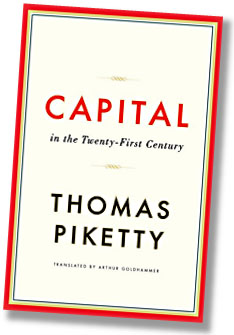
An Economist Answers Some of My Questions About “Capital in the 21st Century”


On Thursday I posted a couple of very rudimentary comments regarding Thomas Piketty’s blockbuster new book, Capital in the 21st Century. I had questions about Piketty’s estimates of r (return on capital) and g (economic growth) in the past and—much more importantly—how they were likely to play out in the future. But all I had were amateur musings because I am, after all, only an amateur.

However, yesterday Brad DeLong tackled some of the questions I asked in a far more rigorous and disciplined way, teasing out a lot of unstated implications along the way—including the importance of various measures of r and how they relate to the probability of increasing future wealth concentration in the real world. It’s a long post, and complex in places, but highly recommended. If you’re willing to work your way through it, DeLong provides a framework for thinking about Piketty’s model that helps you start to make sense of both the book and its conclusions.

POSTSCRIPT: I’ve gotten a couple of questions about why I seem unduly skeptical, or even harsh, about Piketty’s book. It’s obviously a landmark work, I don’t really mean to be unfair. But it’s a book with innovative and untested ideas that has obvious appeal to anyone left of center, and I think this is precisely the time to avoid unquestioning hosannas. Affinity bias makes us all sympathetic to Piketty’s arguments, and that’s why we should instead question it carefully and thoroughly.

If you buy a book using our Bookshop link, a small share of the proceeds supports our journalism.

BEFORE YOU CLICK AWAY!

December is make or break for us. A full one-third of our annual fundraising comes in this month alone. A strong December means our newsroom is on the beat and reporting at full strength. A weak one means budget cuts and hard choices ahead.

The December 31 deadline is closing in fast. To reach our $400,000 goal, we need readers who’ve never given before to join the ranks of MoJo donors. And we need our steadfast supporters to give again today—any amount.

Managing an independent, nonprofit newsroom is staggeringly hard. There’s no cushion in our budget—no backup revenue, no corporate safety net. We can’t afford to fall short, and we can’t rely on corporations or deep-pocketed interests to fund the fierce, investigative journalism Mother Jones exists to do.

That’s why we need you right now. Please chip in to help close the gap.

BEFORE YOU CLICK AWAY!

December is make or break for us. A full one-third of our annual fundraising comes in this month alone. A strong December means our newsroom is on the beat and reporting at full strength. A weak one means budget cuts and hard choices ahead.

The December 31 deadline is closing in fast. To reach our $400,000 goal, we need readers who’ve never given before to join the ranks of MoJo donors. And we need our steadfast supporters to give again today—any amount.

Managing an independent, nonprofit newsroom is staggeringly hard. There’s no cushion in our budget—no backup revenue, no corporate safety net. We can’t afford to fall short, and we can’t rely on corporations or deep-pocketed interests to fund the fierce, investigative journalism Mother Jones exists to do.

That’s why we need you right now. Please chip in to help close the gap.

We Recommend

Latest

Sign up for our free newsletter

Subscribe to the Mother Jones Daily to have our top stories delivered directly to your inbox.

Get our award-winning magazine

Save big on a full year of investigations, ideas, and insights.

Subscribe

Support our journalism

Help Mother Jones' reporters dig deep with a tax-deductible donation.

Donate