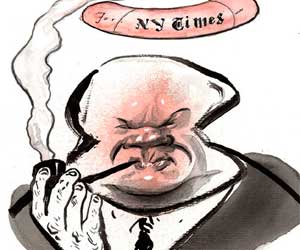
Brodner’s Cartoon du Jour: Wither Print: 1 of 3

Get your news from a source that’s not owned and controlled by oligarchs. Sign up for the free Mother Jones Daily.


Gradually coming into focus is the very harsh prospect of a world without newspapers. McClatchy just announced more job cuts; the LA Times is becoming a shadow of what it was. The Rocky Mountain News is gone and the SF Chronicle may be the first newspaper to go, leaving a major city newspaperless. The NY Times, though privately owned, cannot sustain huge losses indefinitely. So what does this mean? I wouldn’t be so gravely concerned if there was something even remotely like a newspaper for organizing and delivering news. It is not just the investment in newsgathering that will be lost. It is also the issue of DESIGN. Unlike the Web, which has almost no design in media sites. Here design is integral in giving the reader a sense of the scope and weight of news. Only a newspaper does that. In the future I am sure the Web will because it will have to. But what about in the interim? It is in those cracks that very bad things can grow. Journalism is the fourth branch of government. Losing a big part of it will mean important things can be more easily hidden. I feel this is too important for the market to solve. Here is the first of a series of voices on the topic. The first is Bruce Bartlett, former Treasury Dept. economist under HW Bush writing on Forbes.com:

“Personally, I am partial to the nonprofit model. Foundations, universities, think tanks and even political parties might sponsor publications. For example, the Ford Foundation might take over The New York Times, Harvard University might buy The Boston Globe and the Heritage Foundation might assume control of [sic] The Washington Times. They could run these publications without expectation of profit and a [sic] least keep alive the basic journalistic function.”


BEFORE YOU CLICK AWAY!

December is make or break for us. A full one-third of our annual fundraising comes in this month alone. A strong December means our newsroom is on the beat and reporting at full strength. A weak one means budget cuts and hard choices ahead.

The December 31 deadline is closing in fast. To reach our $400,000 goal, we need readers who’ve never given before to join the ranks of MoJo donors. And we need our steadfast supporters to give again today—any amount.

Managing an independent, nonprofit newsroom is staggeringly hard. There’s no cushion in our budget—no backup revenue, no corporate safety net. We can’t afford to fall short, and we can’t rely on corporations or deep-pocketed interests to fund the fierce, investigative journalism Mother Jones exists to do.

That’s why we need you right now. Please chip in to help close the gap.

BEFORE YOU CLICK AWAY!

December is make or break for us. A full one-third of our annual fundraising comes in this month alone. A strong December means our newsroom is on the beat and reporting at full strength. A weak one means budget cuts and hard choices ahead.

The December 31 deadline is closing in fast. To reach our $400,000 goal, we need readers who’ve never given before to join the ranks of MoJo donors. And we need our steadfast supporters to give again today—any amount.

Managing an independent, nonprofit newsroom is staggeringly hard. There’s no cushion in our budget—no backup revenue, no corporate safety net. We can’t afford to fall short, and we can’t rely on corporations or deep-pocketed interests to fund the fierce, investigative journalism Mother Jones exists to do.

That’s why we need you right now. Please chip in to help close the gap.

We Recommend

Latest

Sign up for our free newsletter

Subscribe to the Mother Jones Daily to have our top stories delivered directly to your inbox.

Get our award-winning magazine

Save big on a full year of investigations, ideas, and insights.

Subscribe

Support our journalism

Help Mother Jones' reporters dig deep with a tax-deductible donation.

Donate