The Horseshoe Crab Economy

Wikimedia Commons

Get your news from a source that’s not owned and controlled by oligarchs. Sign up for the free Mother Jones Daily.


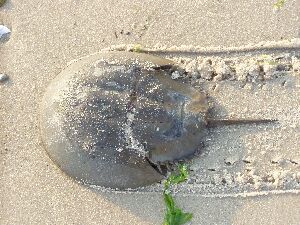
It’s also a global economy that affects millions. Notably, millions of little shorebirds known as red knots, whose numbers have declined 75 percent since the horseshoe crab fishery in Delaware Bay exploded. Prior to 1992, 100,000 crabs a year were caught. In 1997, more than 2 million. The result: 90 percent fewer crab eggs for visiting shorebirds to eat.

Here’s the background: A lot of migrating shorebirds depend on Delaware Bay as a feeding stop. Red knots can’t live without it. Until 1992 the Bay was a dependable fuel station on their annual 18,600-mile migration between the Arctic and the southern tip of South America and back. That’s right, 18,600 miles a year. Fifty percent more flying than the average American drives per year. All from a bird weighing 6 ounces.

Now a new study has found the proportion of red knots visiting Delaware Bay who manage to pack on enough weight to survive the winter in Tierra del Fuego dropped along with the crab eggs. In fact the proportion of birds who made their target weight by their target departure date declined between 50 and 75 percent between 1997 and 2007.

This despite fisheries restrictions enacted in 1997 to help red knots recover. But, tell me, what kind of restrictions allow a 2007 horseshoe crab hunt bigger than the 1990 hunt?

Idiot restrictions. I wrote about other amazing long-distance fliers in Diet for a Warm Planet: how their thriftiness equals their prosperity. We all need to learn from these extraordinary feathered economists. Especially those who practice idiot economics.

BEFORE YOU CLICK AWAY!

December is make or break for us. A full one-third of our annual fundraising comes in this month alone. A strong December means our newsroom is on the beat and reporting at full strength. A weak one means budget cuts and hard choices ahead.

The December 31 deadline is closing in fast. To reach our $400,000 goal, we need readers who’ve never given before to join the ranks of MoJo donors. And we need our steadfast supporters to give again today—any amount.

Managing an independent, nonprofit newsroom is staggeringly hard. There’s no cushion in our budget—no backup revenue, no corporate safety net. We can’t afford to fall short, and we can’t rely on corporations or deep-pocketed interests to fund the fierce, investigative journalism Mother Jones exists to do.

That’s why we need you right now. Please chip in to help close the gap.

BEFORE YOU CLICK AWAY!

December is make or break for us. A full one-third of our annual fundraising comes in this month alone. A strong December means our newsroom is on the beat and reporting at full strength. A weak one means budget cuts and hard choices ahead.

The December 31 deadline is closing in fast. To reach our $400,000 goal, we need readers who’ve never given before to join the ranks of MoJo donors. And we need our steadfast supporters to give again today—any amount.

Managing an independent, nonprofit newsroom is staggeringly hard. There’s no cushion in our budget—no backup revenue, no corporate safety net. We can’t afford to fall short, and we can’t rely on corporations or deep-pocketed interests to fund the fierce, investigative journalism Mother Jones exists to do.

That’s why we need you right now. Please chip in to help close the gap.

We Recommend

Latest

Sign up for our free newsletter

Subscribe to the Mother Jones Daily to have our top stories delivered directly to your inbox.

Get our award-winning magazine

Save big on a full year of investigations, ideas, and insights.

Subscribe

Support our journalism

Help Mother Jones' reporters dig deep with a tax-deductible donation.

Donate