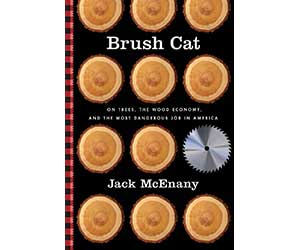
Books: Brush Cat

On trees, the wood economy, and the most dangerous job in America.

Get your news from a source that’s not owned and controlled by oligarchs. Sign up for the free Mother Jones Daily.


Dead trees go into everything from your toilet paper to your McDonald’s milk shake (thickened with wood flour!). As Jack McEnany writes in Brush Cat, it all starts “with some guy trudging into the woods with a chainsaw.” That guy has an increasingly tough job: Climate change has shortened the New England timber season from six months to four, the housing crash has caused the price of lumber to plummet, and logging is America’s deadliest occupation, more dangerous than even deep-sea fishing.

Set in the northern woods of New Hampshire, where McEnany has lived for 20 years, Brush Cat is a sympathetic look at the challenges facing this dying American industry. The book is “mainly about people”: loggers, mill owners, waitresses at breakfast joints, and a host of others who enable us to use wood and paper, well, like they grow on trees. McEnany’s respect for his subjects is reflected in his amusing prose (“Bob used his saw with the authority of a Benihana chef”) and his earnest attempt to follow a logger who agrees to have a “yutz like me with him in the woods” only “for as long as we can stand each other.”

Loggers’ skills are less in demand now than ever. Not that we’re cutting down fewer trees; it’s just that fewer Americans are wielding the saws. Machines are doing more of the harvesting, and much of our wood now comes from Siberia and Southeast Asia. In the US, what was once big business is now a novelty. McEnany asks the owner of a mill town turned theme park in Berlin, New Hampshire, about logging’s transformation from the state’s No. 1 industry to a tourist attraction. “The mill is gone,” he says wistfully, but “the memory isn’t.”


If you buy a book using our Bookshop link, a small share of the proceeds supports our journalism.

BEFORE YOU CLICK AWAY!

December is make or break for us. A full one-third of our annual fundraising comes in this month alone. A strong December means our newsroom is on the beat and reporting at full strength. A weak one means budget cuts and hard choices ahead.

The December 31 deadline is closing in fast. To reach our $400,000 goal, we need readers who’ve never given before to join the ranks of MoJo donors. And we need our steadfast supporters to give again today—any amount.

Managing an independent, nonprofit newsroom is staggeringly hard. There’s no cushion in our budget—no backup revenue, no corporate safety net. We can’t afford to fall short, and we can’t rely on corporations or deep-pocketed interests to fund the fierce, investigative journalism Mother Jones exists to do.

That’s why we need you right now. Please chip in to help close the gap.

BEFORE YOU CLICK AWAY!

December is make or break for us. A full one-third of our annual fundraising comes in this month alone. A strong December means our newsroom is on the beat and reporting at full strength. A weak one means budget cuts and hard choices ahead.

The December 31 deadline is closing in fast. To reach our $400,000 goal, we need readers who’ve never given before to join the ranks of MoJo donors. And we need our steadfast supporters to give again today—any amount.

Managing an independent, nonprofit newsroom is staggeringly hard. There’s no cushion in our budget—no backup revenue, no corporate safety net. We can’t afford to fall short, and we can’t rely on corporations or deep-pocketed interests to fund the fierce, investigative journalism Mother Jones exists to do.

That’s why we need you right now. Please chip in to help close the gap.

We Recommend

Latest

Sign up for our free newsletter

Subscribe to the Mother Jones Daily to have our top stories delivered directly to your inbox.

Get our award-winning magazine

Save big on a full year of investigations, ideas, and insights.

Subscribe

Support our journalism

Help Mother Jones' reporters dig deep with a tax-deductible donation.

Donate