Books: Fact-check, Mate

Get your news from a source that’s not owned and controlled by oligarchs. Sign up for the free Mother Jones Daily.


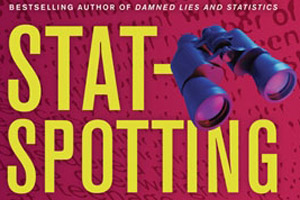
Joel Best’s Stat-Spotting: A Field Guide to Identifying Dubious Data, belongs on the nightstand of anyone who regularly encounters statistics—which is to
say, everyone. In my line of work as a fact-checker, the book’s case studies are
even more of a must-read.

Take, for example, this health
statistic, repeated on a number of websites: Each year, 20,000 people die from
taking aspirin.

Best proffers a number of tips that challenge this factoid’s accuracy.

#1: If something sounds too shocking to be true, it probably is.

Check.

#2: Make sure sources aren’t biased.

The stat appears on a site titled What Doctors Don’t Tell You and a page promoting magnetic therapy as an alternative to (you guessed it) aspirin.

#3: Look for “botched translations”—numbers simplified to the point of inaccuracy.

Checking in with the FDA (a trusted source that appears to be the original), we find that an estimated 10,000-20,000 people die a year from NSAID (Nonsteroidal Inflammatory Drugs) complications. Aspirin is indeed an NSAID, but so are several other drugs, including ibuprofen. So this figure unfairly singles out aspirin, omits the “complications” modifier, and uses the highest figure from a broad number range. It’s also a stat from 1999.

Mate.

This example illustrates just how easy it is for a number to be misrepresented, and how it can quickly take on a life of its own. And Best reveals how even major publications and news networks propagate misinformation.

It’s tempting after reading Stat-Spotting to throw up your hands and turn against data entirely. But the tome successfully shows how to sort the muck from the truth, which is out there. And as Best says, “We need quantitative data—statistics—to guide us.”

In other words, we need stats to make sense of the world. We just need to know how to make sense of the stats.


BEFORE YOU CLICK AWAY!

December is make or break for us. A full one-third of our annual fundraising comes in this month alone. A strong December means our newsroom is on the beat and reporting at full strength. A weak one means budget cuts and hard choices ahead.

The December 31 deadline is closing in fast. To reach our $400,000 goal, we need readers who’ve never given before to join the ranks of MoJo donors. And we need our steadfast supporters to give again today—any amount.

Managing an independent, nonprofit newsroom is staggeringly hard. There’s no cushion in our budget—no backup revenue, no corporate safety net. We can’t afford to fall short, and we can’t rely on corporations or deep-pocketed interests to fund the fierce, investigative journalism Mother Jones exists to do.

That’s why we need you right now. Please chip in to help close the gap.

BEFORE YOU CLICK AWAY!

December is make or break for us. A full one-third of our annual fundraising comes in this month alone. A strong December means our newsroom is on the beat and reporting at full strength. A weak one means budget cuts and hard choices ahead.

The December 31 deadline is closing in fast. To reach our $400,000 goal, we need readers who’ve never given before to join the ranks of MoJo donors. And we need our steadfast supporters to give again today—any amount.

Managing an independent, nonprofit newsroom is staggeringly hard. There’s no cushion in our budget—no backup revenue, no corporate safety net. We can’t afford to fall short, and we can’t rely on corporations or deep-pocketed interests to fund the fierce, investigative journalism Mother Jones exists to do.

That’s why we need you right now. Please chip in to help close the gap.

We Recommend

Latest

Sign up for our free newsletter

Subscribe to the Mother Jones Daily to have our top stories delivered directly to your inbox.

Get our award-winning magazine

Save big on a full year of investigations, ideas, and insights.

Subscribe

Support our journalism

Help Mother Jones' reporters dig deep with a tax-deductible donation.

Donate