Rapid Retreat of Columbia Glacier


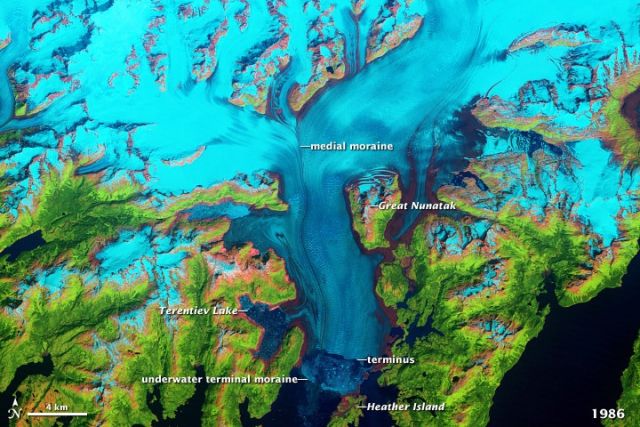
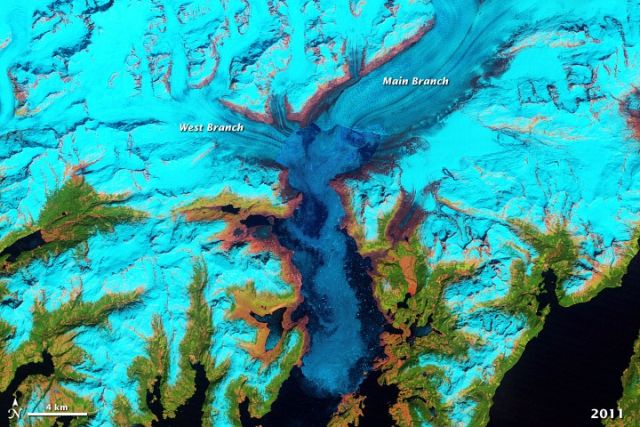
Columbia Glacier in 1986 (top) and 2011 (bottom): NASAColumbia Glacier, Alaska, in 1986 (top) and 2011 (bottom): NASA

Alaska’s Columbia Glacier is one of the fastest evolving ice rivers on Earth. It flows from its headwaters 10,000 feet up in the Chugach Mountains towards Prince William Sound. In 1980 it began a rapid retreat that continues today. From NASA Earth Observatory:

These two false-color images, both captured by the Thematic Mapper (TM) instrument on Landsat 5, show the glacier and the surrounding landscape in 1986 and 2011. Snow and ice appears bright cyan, vegetation is green, clouds are white or light orange, and the open ocean is dark blue. Exposed bedrock is brown, while rocky debris on the glacier’s surface is gray. The 2011 image has more snow because it was captured in May, while the 1986 image was captured in July… As the glacier has retreated, it has also thinned substantially, as shown by the expansion of brown bedrock areas. Rings of freshly exposed rock, known as trimlines, are prominent in the later image. Since the 1980s, the glacier has lost about half of its total thickness and volume.

The retreat has also changed the flow dynamics of the glacier. The medial moraine—a line of debris deposited when separate channels of ice merge (seen as a line down the center of the 1986 glacier)—divided the Main Branch from West Branch in 1986. Now the retreating terminus has effectively split the Columbia into two glaciers, with calving occurring on both fronts.


BEFORE YOU CLICK AWAY!

December is make or break for us. A full one-third of our annual fundraising comes in this month alone. A strong December means our newsroom is on the beat and reporting at full strength. A weak one means budget cuts and hard choices ahead.

The December 31 deadline is closing in fast. To reach our $400,000 goal, we need readers who’ve never given before to join the ranks of MoJo donors. And we need our steadfast supporters to give again today—any amount.

Managing an independent, nonprofit newsroom is staggeringly hard. There’s no cushion in our budget—no backup revenue, no corporate safety net. We can’t afford to fall short, and we can’t rely on corporations or deep-pocketed interests to fund the fierce, investigative journalism Mother Jones exists to do.

That’s why we need you right now. Please chip in to help close the gap.

BEFORE YOU CLICK AWAY!

December is make or break for us. A full one-third of our annual fundraising comes in this month alone. A strong December means our newsroom is on the beat and reporting at full strength. A weak one means budget cuts and hard choices ahead.

The December 31 deadline is closing in fast. To reach our $400,000 goal, we need readers who’ve never given before to join the ranks of MoJo donors. And we need our steadfast supporters to give again today—any amount.

Managing an independent, nonprofit newsroom is staggeringly hard. There’s no cushion in our budget—no backup revenue, no corporate safety net. We can’t afford to fall short, and we can’t rely on corporations or deep-pocketed interests to fund the fierce, investigative journalism Mother Jones exists to do.

That’s why we need you right now. Please chip in to help close the gap.

We Recommend

Latest

Sign up for our free newsletter

Subscribe to the Mother Jones Daily to have our top stories delivered directly to your inbox.

Get our award-winning magazine

Save big on a full year of investigations, ideas, and insights.

Subscribe

Support our journalism

Help Mother Jones' reporters dig deep with a tax-deductible donation.

Donate