Credit Conditions are Still a Headwind Against Economic Recovery

Get your news from a source that’s not owned and controlled by oligarchs. Sign up for the free Mother Jones Daily.

I don’t even quite know what to make of this chart from Karl Smith, but here it is anyway for everyone to ponder. The red line represents employment by the government and by goods-producing sectors. Kablooey! The blue line represents employment by everyone else. Not bad!
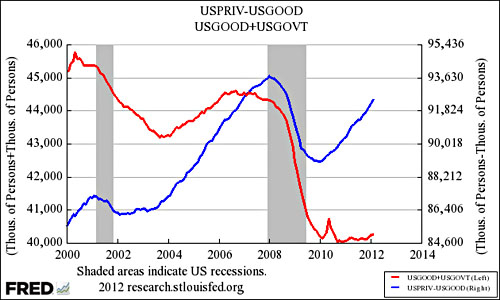
Karl’s take is that this demonstrates that the economy is still highly sensitive to credit conditions:

We are largely talking about construction workers, metal and automotive workers, and school teachers. These workers are massively influenced by credit constraints. One cannot build a building without credit. One cannot buy a vehicle without credit and state and local governments have very little credit room by statute.

So what we need for job growth to really hit its stride is for construction to come back, cars to come back and school teachers to come back….Because these sectors respond so much to liquidity the job recovery is still fragile.

I’m not sure I buy the idea that government as a whole is sensitive to credit constraints. Obviously the federal government isn’t, and states are constrained by balanced-budget requirements at all times. But perhaps the ease of issuing state and municipal bonds has plummeted during the recession? I’m not sure.

Generally speaking, I suspect this chart says more about the housing/construction market in particular than it does about broader capital goods, which I think have rebounded fairly decently over the past year or two. It also says something about reduced state and local spending, though I don’t think it’s fair to call that a credit issue. It’s more a statutory problem combined with bad austerity policy at the federal level. Further thoughts welcome, though.

BEFORE YOU CLICK AWAY!

December is make or break for us. A full one-third of our annual fundraising comes in this month alone. A strong December means our newsroom is on the beat and reporting at full strength. A weak one means budget cuts and hard choices ahead.

The December 31 deadline is closing in fast. To reach our $400,000 goal, we need readers who’ve never given before to join the ranks of MoJo donors. And we need our steadfast supporters to give again today—any amount.

Managing an independent, nonprofit newsroom is staggeringly hard. There’s no cushion in our budget—no backup revenue, no corporate safety net. We can’t afford to fall short, and we can’t rely on corporations or deep-pocketed interests to fund the fierce, investigative journalism Mother Jones exists to do.

That’s why we need you right now. Please chip in to help close the gap.

BEFORE YOU CLICK AWAY!

December is make or break for us. A full one-third of our annual fundraising comes in this month alone. A strong December means our newsroom is on the beat and reporting at full strength. A weak one means budget cuts and hard choices ahead.

The December 31 deadline is closing in fast. To reach our $400,000 goal, we need readers who’ve never given before to join the ranks of MoJo donors. And we need our steadfast supporters to give again today—any amount.

Managing an independent, nonprofit newsroom is staggeringly hard. There’s no cushion in our budget—no backup revenue, no corporate safety net. We can’t afford to fall short, and we can’t rely on corporations or deep-pocketed interests to fund the fierce, investigative journalism Mother Jones exists to do.

That’s why we need you right now. Please chip in to help close the gap.

We Recommend

Latest

Sign up for our free newsletter

Subscribe to the Mother Jones Daily to have our top stories delivered directly to your inbox.

Get our award-winning magazine

Save big on a full year of investigations, ideas, and insights.

Subscribe

Support our journalism

Help Mother Jones' reporters dig deep with a tax-deductible donation.

Donate