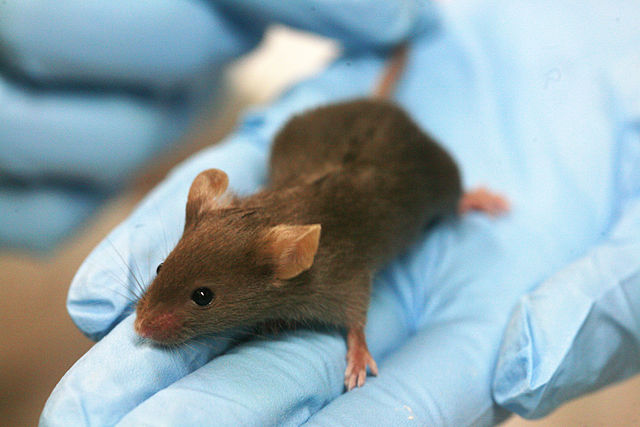
Chemotherapy Tweaks DNA of Mouse Offspring Too

Credit: Rama at <a href="http://commons.wikimedia.org/wiki/File:Lab_mouse_mg_3263.jpg">Wikimedia Commons</a>.

Get your news from a source that’s not owned and controlled by oligarchs. Sign up for the free Mother Jones Daily.


A new paper in PNAS reports that three common chemotherapy drugs destabilize DNA in mice enough to trigger new mutations long after exposure to the drugs has ceased—mutations which are then passed down to their untreated offspring.

A similar phenomenon has been observed in mice exposed to radiation.

Nature News reports on the original radiation findings:

[Co-author and geneticist Yuri] Dubrova and his colleagues were studying the effects of radiation when, purely by chance, they decided to look at mutation rates in the offspring of exposed mice. ‘What we found was the biggest surprise of my life,’ he says. The children had several times more mutations in their eggs and sperm than their radiation-treated parents. ‘The genomes were unstable, and we still don’t know why.’

The researchers surmised that chemotherapy drugs might trigger even stronger genetic effects, since chemotherapy is given systemically and radiation therapy isn’t. So they investigated three common drugs—cyclophosphamide, mitomycin C and procarbazine—at mouse doses comparable to people doses, in the offspring of treated male mice. From the PNAS paper

After paternal exposure to any one of these three drugs, expanded simple tandem repeat mutation frequencies were significantly elevated in the germ line (sperm) and bone marrow of their offspring. This… was attributed to elevated mutation rates at the alleles derived from both the exposed fathers and from the nonexposed mothers, thus implying a genome-wide destabilization.

DNA mutations tend to accumulate in the genomes of offspring mice more than in their parents.

The researchers caution:

Our data also raise important issues concerning delayed transgenerational effects in the children of survivors of anticancer therapy.

Although Nature News points out that mice only live two years and so pass on their damaged DNA before there’s much time for internal repair, whereas most humans treated for cancer are post-reproductive adults or adults made sterile by treatment:

‘So we’re talking about one group only: childhood cancer survivors,’ says Dubrova. One recent study found no significant impact of radiation or chemotherapy on the rate of birth defects in 4,699 children of childhood cancer survivors.


 

BEFORE YOU CLICK AWAY!

December is make or break for us. A full one-third of our annual fundraising comes in this month alone. A strong December means our newsroom is on the beat and reporting at full strength. A weak one means budget cuts and hard choices ahead.

The December 31 deadline is closing in fast. To reach our $400,000 goal, we need readers who’ve never given before to join the ranks of MoJo donors. And we need our steadfast supporters to give again today—any amount.

Managing an independent, nonprofit newsroom is staggeringly hard. There’s no cushion in our budget—no backup revenue, no corporate safety net. We can’t afford to fall short, and we can’t rely on corporations or deep-pocketed interests to fund the fierce, investigative journalism Mother Jones exists to do.

That’s why we need you right now. Please chip in to help close the gap.

BEFORE YOU CLICK AWAY!

December is make or break for us. A full one-third of our annual fundraising comes in this month alone. A strong December means our newsroom is on the beat and reporting at full strength. A weak one means budget cuts and hard choices ahead.

The December 31 deadline is closing in fast. To reach our $400,000 goal, we need readers who’ve never given before to join the ranks of MoJo donors. And we need our steadfast supporters to give again today—any amount.

Managing an independent, nonprofit newsroom is staggeringly hard. There’s no cushion in our budget—no backup revenue, no corporate safety net. We can’t afford to fall short, and we can’t rely on corporations or deep-pocketed interests to fund the fierce, investigative journalism Mother Jones exists to do.

That’s why we need you right now. Please chip in to help close the gap.

We Recommend

Latest

Sign up for our free newsletter

Subscribe to the Mother Jones Daily to have our top stories delivered directly to your inbox.

Get our award-winning magazine

Save big on a full year of investigations, ideas, and insights.

Subscribe

Support our journalism

Help Mother Jones' reporters dig deep with a tax-deductible donation.

Donate