Social Mobility in America: It’s All About the Poor

Get your news from a source that’s not owned and controlled by oligarchs. Sign up for the free Mother Jones Daily.

Social mobility in America, as near as I can tell, has stayed roughly the same over the past few decades. If you’re born to poor parents today, it’s about as hard to move up into the middle (or upper) classes as it was 50 years ago.

But as Jason DeParle writes today in the New York Times, it’s also true that social mobility is a lot lower in America than in most other developed countries. Jared Bernstein points out that this is partly because income inequality in America is so high: you need a lot more money to move into the top 20% here than you do in Denmark. If we had less income inequality — if the poor families started out a little less poor and the rich families were a little less rich — we’d be a more mobile society too.

But it’s worth drilling down a bit and asking what, precisely, is it that America does so badly at? The Times piece includes a chart comparing America to Denmark, which makes things pretty clear:
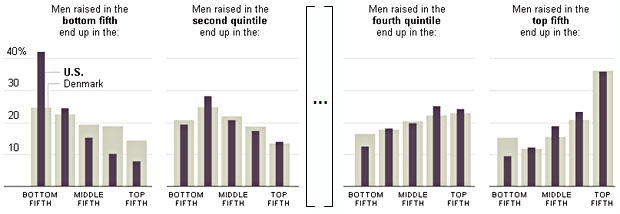
On the far left, you can see the only really big difference between the countries: the poorest kids in America are far more likely to stay poor than they are in Denmark and far less likely to get rich. And that’s pretty much it. If you look at all the other quintiles (I took out the middle quintile to make the chart legible at this size, but it shows the same thing as the others), you see that there’s not a lot of difference. And what difference there is favors the U.S. as often as it does Denmark.

So that’s the problem: lousy opportunities for the very poorest kids. They start out worse off than Danish kids, and they end up worse off than Danish adults. There’s no single reason for this, but one of the big ones is early childhood education. Danes do a much better job on this score than we do, and if we put more money and energy into this I’ll bet it would make a big difference.

BEFORE YOU CLICK AWAY!

December is make or break for us. A full one-third of our annual fundraising comes in this month alone. A strong December means our newsroom is on the beat and reporting at full strength. A weak one means budget cuts and hard choices ahead.

The December 31 deadline is closing in fast. To reach our $400,000 goal, we need readers who’ve never given before to join the ranks of MoJo donors. And we need our steadfast supporters to give again today—any amount.

Managing an independent, nonprofit newsroom is staggeringly hard. There’s no cushion in our budget—no backup revenue, no corporate safety net. We can’t afford to fall short, and we can’t rely on corporations or deep-pocketed interests to fund the fierce, investigative journalism Mother Jones exists to do.

That’s why we need you right now. Please chip in to help close the gap.

BEFORE YOU CLICK AWAY!

December is make or break for us. A full one-third of our annual fundraising comes in this month alone. A strong December means our newsroom is on the beat and reporting at full strength. A weak one means budget cuts and hard choices ahead.

The December 31 deadline is closing in fast. To reach our $400,000 goal, we need readers who’ve never given before to join the ranks of MoJo donors. And we need our steadfast supporters to give again today—any amount.

Managing an independent, nonprofit newsroom is staggeringly hard. There’s no cushion in our budget—no backup revenue, no corporate safety net. We can’t afford to fall short, and we can’t rely on corporations or deep-pocketed interests to fund the fierce, investigative journalism Mother Jones exists to do.

That’s why we need you right now. Please chip in to help close the gap.

We Recommend

Latest

Sign up for our free newsletter

Subscribe to the Mother Jones Daily to have our top stories delivered directly to your inbox.

Get our award-winning magazine

Save big on a full year of investigations, ideas, and insights.

Subscribe

Support our journalism

Help Mother Jones' reporters dig deep with a tax-deductible donation.

Donate