Washington Doesn’t Have a Spending Problem. It Has a Health Care Problem. Period.

Get your news from a source that’s not owned and controlled by oligarchs. Sign up for the free Mother Jones Daily.

Earlier today I wrote a post saying flatly, “We don’t suffer from runaway spending.” Our only long-term problems are an aging population and rising health care costs. That’s it. In case you, or a conservative loved one, doesn’t believe this, here’s a chart I posted last year that tells the basic story of federal spending:
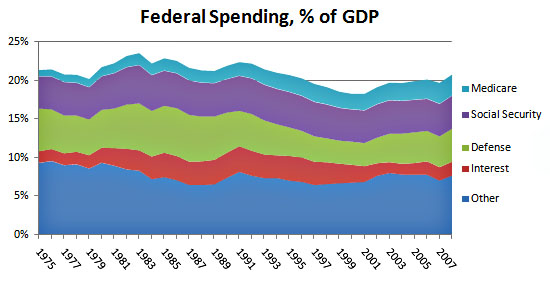
First off, notice that total federal spending is down—not up—from its peak during the Reagan-Bush years. More specifically, the category that contains domestic discretionary spending and miscellaneous mandatory spending (“Other”) has been on a steady downward slope for decades. It spikes a bit during recessions, but that’s about it.

Interest expense is also down. Defense spending swelled back up to late-80s levels after 9/11, but is otherwise down over the long term too. And Social Security spending is pretty flat, though it will go up a point or two over the next few decades before it levels out again. The only category that’s on a long-term upward slope is Medicare.

In other words, we don’t have a discretionary spending problem. We don’t have an interest expense problem. Once we withdraw from Afghanistan we don’t have a big defense spending problem. And Social Security, at worst, is a very small and very manageable problem.

Our only serious problem is Medicare, thanks to an aging population and rising health care costs. That’s it. End of story. If you actually care about federal spending, that’s the only thing you should be focused on. Pundits and talking heads who complain generically about “out-of-control spending” are either (a) ignorant of basic budget facts or (b) engaged in agitprop.

NOTE: This chart deliberately stops at 2008 in order to show historical trends more clearly. The numbers in the chart have spiked over the past four years because the recession has temporarily depressed GDP and temporarily increased spending, but that spike will disappear naturally as the economy recovers—just as it has after every other recession. It’s not an indication of a long-term spiral in federal spending.

BEFORE YOU CLICK AWAY!

December is make or break for us. A full one-third of our annual fundraising comes in this month alone. A strong December means our newsroom is on the beat and reporting at full strength. A weak one means budget cuts and hard choices ahead.

The December 31 deadline is closing in fast. To reach our $400,000 goal, we need readers who’ve never given before to join the ranks of MoJo donors. And we need our steadfast supporters to give again today—any amount.

Managing an independent, nonprofit newsroom is staggeringly hard. There’s no cushion in our budget—no backup revenue, no corporate safety net. We can’t afford to fall short, and we can’t rely on corporations or deep-pocketed interests to fund the fierce, investigative journalism Mother Jones exists to do.

That’s why we need you right now. Please chip in to help close the gap.

BEFORE YOU CLICK AWAY!

December is make or break for us. A full one-third of our annual fundraising comes in this month alone. A strong December means our newsroom is on the beat and reporting at full strength. A weak one means budget cuts and hard choices ahead.

The December 31 deadline is closing in fast. To reach our $400,000 goal, we need readers who’ve never given before to join the ranks of MoJo donors. And we need our steadfast supporters to give again today—any amount.

Managing an independent, nonprofit newsroom is staggeringly hard. There’s no cushion in our budget—no backup revenue, no corporate safety net. We can’t afford to fall short, and we can’t rely on corporations or deep-pocketed interests to fund the fierce, investigative journalism Mother Jones exists to do.

That’s why we need you right now. Please chip in to help close the gap.

We Recommend

Latest

Sign up for our free newsletter

Subscribe to the Mother Jones Daily to have our top stories delivered directly to your inbox.

Get our award-winning magazine

Save big on a full year of investigations, ideas, and insights.

Subscribe

Support our journalism

Help Mother Jones' reporters dig deep with a tax-deductible donation.

Donate